Commentary on Movies and TV by Brian Holcomb

Saturday, August 29, 2009

THE BARON OF ARIZONA Review

by Brian Holcomb

Director Sam Fuller is like that crazy uncle your family is afraid of having over for Thanksgiving. He says exactly what's on his mind and what's on his mind is so one sided that any mild dissent is likely to descend immediately into a shouting match over the cranberry sauce.


The thing is the man is right. He's even right when he's wrong because he tries so hard to speak the truth straight from his heart . You have to admire a man of such conviction.

This film, The Baron of Arizona (1950) is about the craziest true story I've never heard of that turned out to be pretty damn true. Even with Fuller shouting his own melodramatic version of the truth at the top of his lungs. It's really a great flick.

Who ever heard of this James Addison Reavis guy ? A guy who almost swindled the United States out of Arizona. I mean, he actually claimed ownership of the territory around and including the state of Arizona and moved there with his wife to lord over the unwilling locals as their "Baron". The US government apparently was dumbfounded by the incredible authenticity of his claim and unable to prove it a fraud for over a year. I know what you're thinking, "What? This really happened?" Well, a few clicks on the google device gets us a nice wikipedia entry that seems to hold up most of Fuller's claim that this is a "true story".

Vincent Price plays the Baron and his performance is right in line with the neurotic cads that he had been known for since his classic performance in Otto Preminger's Laura. This road would eventually lead him to the mostly great Corman Poe adaptations which would eventually lead him into becoming a parody of himself. But this is an early performance and it's one of his best, right up there with Matthew Hopkins in The Witchfinder General. The difference here is that Price's Baron is a great anti-hero rather than villain. You know the whole time that he's using people, lying to everyone and yet you can't help but admire him. Any man who is willing to invest years forging papers and deeds to create a fictional history of a family claim has to be admired on a purely mercenary level.

In the film James Reavis is shown joining an order of monks in California and living among them for what seems like months in order to earn their trust . All to get his hands on one of the original copies of the local land records and to use the very specific ink they make in their monastery to make a few important changes. The fact that this ends in failure and does not stop him is amazing. He just pushes on, finding another way to get at the original records and even marrying into the Peralta family to seal the illusion.


The film has an unusual effect. As you watch Reavis weave his web, you are on his side. As he achieves his goal and takes control of Arizona from an absurd James Bond styled headquarters (complete with a giant map of his kingdom on the wall), you still hope that the government fools won't find a flaw in his brilliant forgeries. Even the "good" people of Arizona start looking like monsters, turning into a mad lynch mob out for blood. But it's his treatment of his innocent wife that makes you question his actions. And since this is grand melodrama, Reavis questions his own actions as well and like the Grinch, his heart grows three sizes overnight. Fuller rushes this a bit and seems somewhat dispassionate about the man's redemption. He's much more excited by the fact that the locals couldn't care less about his change of heart and intend on burning down his evil lair and hanging the Baron and Baroness from a noose.

There is a happy ending of sorts but Reavis seems less redeemed than disappointed as he is released from Prison and surrounded by his family. After all this was a man with massive ambitions for personal power and glory. All he has to look forward to now is a nice dinner with some poor relatives. Too bad he couldn't craft a new plan to steal New York City.

Friday, August 21, 2009

"INGLOURIOUS BASTERDS" Review


by Brian Holcomb

This is a FILM with blood in its veins, a heart in its body and a red hot engine in its chassis. It is alive with ideas and a geniune belief in the power of FILM to express them. As with all great films, Words will fail from the beginning to explain why this is such an amazing piece of cinematic art but we will try to use them.

Alfred Hitchcock used to love to give journalists a characteristically deadpan lesson in suspense filmmaking through an anecdote about "THE TICKING BOMB". The gist of it was that three men sitting around a table talking about baseball or the weather was by the very nature of MOTION pictures-boring. But any scene involving mundane dialogue or exposition becomes instantly suspenseful to the audience once they've been tipped off that a ticking bomb has been placed under the table. The audience would watch AND LISTEN helplessly while the unsuspecting characters went on talking about batting averages or whatever. The audience would think, "Don't talk about baseball you fools, there's a bomb under that table!"


Now, if you're Quentin Tarantino and you love to write dialogue that goes on for pages and pages then this device becomes your secret weapon. How can a filmmaker get an easily distracted audience to sit still while characters ramble on-well, you get the point. Put a bomb under the table and get the audience worked up into a lather. The skill is in coming up with these ticking bombs so that they aren't always LITERAL ticking bombs. In his latest movie, the spelling challenged INGLOURIOUS BASTERDS, Tarantino becomes so skilled at it that he can even make a glass of milk function as a ticking bomb.


Now this isn't to say some kind of reductionary nonsense that Tarantino is the new Hitchcock. God knows there have been plenty of fools who have come forth over the years and tried to take that mantle. The thing is: No One Can. Hitchcock is almost above criticism since his ideas about film form and content have been so influential it is impossible to separate almost ANY filmmaker from his influence. Even if it came second hand.

Tarantino is a filmmaker who deals with art in the second or third hand. He is a post modernist in the tradition of Brian DePalma who plays with film the way Marcel Duchamp may have once played with found objects in a junkyard. The pieces may have come from this old war picture or that old drive-in flick but once they are appropriated they are owned and operated in a whole new way; transformed into something New charged by the power of something Old.

In the brash confidence of his playful surfaces and the complexity of his pop art games, Tarantino along with DePalma have gone farther than Hitchcock could ever go in playing with form and content. Shackled by the commercial cinema he worked within, Hitchcock could only dream of doing the things that Tarantino does without pause. For a brief moment in the late '60s, Hitchcock shot tests for a film called Kaleidoscope which he wanted to photograph on real locations, with more open sexuality and nudity and using handheld cameras and even perhaps 16mm. Basically it was Hitchcock's idea to take what the French New Wave were doing and to bring those techniques under his more seasoned control the way he took TV production techniques and polished them for Psycho.

IMAGES FROM KALEIDOSCOPE TEST FOOTAGE

Of course MCA-Universal to whom Hitchcock had become a prisoner in a gilded cage wanted nothing of the sort from the master of glossy suspense and the project was shelved cutting off what could've been an exciting final phase of creativity from the director. But these techniques are easily used by Tarantino in a much more complex and almost disposable modern manner-thanks to Godard who showed that a filmmaker could basically do ANYTHING-he can shoot intense closeups in widescreen and invoke the cinema of Sergio Leone in one breath-

Robert Aldrich and THE DIRTY DOZEN in the next-

while framing actors in groups with an eye-level camera the way Howard Hawks would-


Every scene is shot for maximum effect from a cinematic standpoint. With Tarantino you get to watch the whole damn history of cinema explode in front of your eyes at 24fps. And in the fiery inferno that engulfs the cinema at the film's climax, the FILM itself literally does explode.


So, what the hell are these INGLOURIOUS BASTERDS? Well, first of all it's not a remake of the correctly spelled Enzo G. Castellari film INGLORIOUS BASTARDS from 1978 though it makes use of the same "men on a mission" plot device as that film did.


This subgenre spins off of classic 60s movies like The Dirty Dozen, Where Eagles Dare and really from Roger Corman's relatively unknown film The Secret Invasion. But sometime between his initial drafts and what finally hit the screen, Tarantino sorta-kinda-abandoned this plot device as the driving force in his film. Certainly there are MEN in the film and they ARE on a MISSION. But they no longer hold the focus of the film which is quite evenly distributed among several characters some of whom never meet throughout the entire 149 minute running time.


These basterds are a mixed crew of Jewish American soldiers led by Col. Aldo Raine (Brad Pitt) whose mission is to kill and scalp as many Nazis as possible and put fear into their hearts. This is what they do in most of their scenes in the film which account for perhaps 40 percent of the running time. The rest is focused on the story of Shoshanna Dreyfus (Mélanie Laurent) whose family is wiped out by the infamous "Jew Hunter" Hans Landa (the incredible Christoph Waltz) in the film's powerful opening sequence. Shoshanna ends up in Paris running a cinema during the Nazi occupation. When a dashing young German soldier (Daniel Bruhl) who is a hero to the Reich for killing hundreds of Allied soldiers falls for her he uses his influence to have her theatre hold the premiere of the propaganda film starring himself and about himself called Nation's Pride. The premiere becomes the center of all the action at the end as Shoshanna sees her chance to avenge her family while the Basterds arrive with their own plan to end the war in one fell swoop: it turns out that not only is the producer of the film, Joseph Goebbels, going to be in attendance but Adolf Hitler himself.

Tarantino doesn't shackle himself to anything with this film. It expresses itself in whatever cinematic vernacular neccessary even indulging in omnscient narration at times through the familiar pipes of Samuel L. Jackson. The score ranges from classic Ennio Morricone pieces and Elmer Bernstein's ZULU theme to David Bowie's title song for Paul Schrader's Cat People "Putting Out Fire". Saving Private Ryan this isn't and thank God. Brad Pitt is in full tonque-in-cheek mode here and he breezes through the movie with his winking wit and hillbilly accent. The real acting kudos go to Mélanie Laurent who looks like a young Denueve but has the fiery intensity of a young Jeanne Moreau and Christoph Waltz whose performance as Hans Landa deservedly earned him the Best Acor prize at the Cannes Film Festival. There are a few minor flaws in the film-Eli Roth's less than convincing performance, Mike Myers overly familiar schtick and the cartoon Adolf Hitler who seems less real than Darth Vader. But not having met the man personally, maybe this was how he carried himself...

There are those who are claiming that this film is some kind of "alternate history" linking it with that peculiar subgenre of generally stiff books in which the South often wins the Civil War or the United States never enters WW2 allowing Hitler to rule Europe to this day. While it's true that Tarantino rewrites history, it's not to wonder about the results of such changes in any fictitious future so much as to revel in the glory of how things could've been if they played out in the wildest fantasy of a pulp writer caught up in his most feverish melodrama. Any resemblance to the real Second World War is purely cosmetic and coincidental. This is a fable played out in broad colours and splashed onscreen from every corner of that storehouse of old movies, Tarantino's mind. Now this doesn't mean that the ideas and consequences of the real world do not affect the film. There is genuine human drama and pain in the film that comes from knowing that the Nazis were real and that many paid the price of their madness. So when Tarantino decides to create his own end to World War 2, he wields this power to create a hallucinatory fantasy of bloodthirsty vengeance. How many would've liked to have seen hundreds of Nazis mowed down in showers of blood or to see the ultimate revenge fantasy, the face of Adolf Hitler shot through again and again by bullets, hot metal tearing at the human flesh and bone and killing the monster over and over ad infinitum.

This climax is a doozy, channeling the works of DePalma (Carrie's fiery prom destruction), Spielberg (Raiders of the Lost Ark's melting Nazis) as well as the slow motion gun ballets of Woo and Peckinpah's entire filmography. But there is a giddyness about the scene that is pure Tarantino, a child-like cruelty expressed in cinematic wish fulfilment fantasies of Nazis trapped like rats, taunted by the face of Shoshanna Dreyfus projected onto the giant screen taunting and laughing at their helplessness; Running for their lives like cowards while the heroic Jews with their weapons blazing settle scores never settled in our own history. And to cap all this off is a single unforgettable and almost throwaway image, one of such power I almost thought I was imagining it: The beams from the projector hitting a wall of rising smoke and creating a ghostly vision of the dead Shoshanna as an Avenging Angel, the very idea of cinematic immortality allowing her to have a posthumous retribution. For Tarantino this is a literal truth, FILM itself brings down the Third Reich.

Friday, July 03, 2009

PUBLIC ENEMIES REVIEW


by Brian Holcomb

Director: Michael Mann
Screenplay: Michael Mann, Ronan Bennett Ann Biderman based on the book by Bryan Burroughs "Public Enemies: America's Greatest Crime Wave and the Birth of the FBI, 1933-1934"
Cast: Johnny Depp, Christian Bale, Marion Cotillard, Stephen Lang, Stephen Dorff, Giovani Ribisi, Leelee Sobieski, Billy Crudup

"Dead as Dillinger"

If you've ever seen the famous newsreel footage of John Dillinger under arrest but acting like a guest at an Awards ceremony, one arm resting on the shoulder of the DA, then you know that this was a unique man-one of the few with that cult of personality that makes a man likable even when his actions are dispicable.

What in the world was going on in that man's mind? Can a man about to be locked up and put on trial for robbery and murder be THAT confident and at ease among his captors?

Well, unfortunately we have to keep wondering since that man is not depicted in this film, the latest cops and robbers saga from director Michael Mann.

At first this seems to be a perfect meeting of raw material and filmmaker. The classic true story of Depression era bank robber and media celebrity John Dillinger (Johnny Depp) being pursued doggedly by straight arrowed G-man Melvin Purvis (Christian Bale) sounds like a piece of ready-made art for the director of HEAT and MIAMI VICE.

The trouble is that just adding water to the mix does not a masterpiece make. Not even good entertainment. Mann has consistently warred with his artistic instincts onscreen and this war has made for some great films. His sensibility is informed partly by the French existential crime melodrama as defined by the work of Jean-Pierre Melville but shadowed by the more direct and efficient crime films of classic American cinema, the lean and muscular films of directors like Don Siegel and Robert Aldrich. When he makes sure that his chocolate is not taking over his peanut butter or vice-versa you get a pop entertainment that seems deep and conjures up feelings and moods way outside of the confines of mere genre. Cop and criminal are both abstracted into wider symbols of mankind lost in a world beyond their comprehension. But don't worry there's gonna be a cool shootout soon.

Now, Mann has had a tendency to lose the plot at times. And I don't just mean the actual plot. In films like THE KEEP, the director seems to forget that he is making a film for popular consumption and completely vaporizes the audience under an avalanche of images pregnant with meaning. He also commits the unpardonable sin of avoiding obligatory scenes-those obvious scenes in drama which everyone can predict will be in the film and yet feel cheated without. This is the first mark of a filmmaker unable to control himself. If the film were purely an art construct then this would not be a problem, but PUBLIC ENEMIES clearly wants to engage the audience as much as it alienates them. So we get a script for an '80s HBO cable movie being directed by a filmmaker who detests its triteness. Something's got to give and here it's the characterization and narrative which fails to convince and fails to entrance.

What Mann gets right about the film has everything to do with its surface since that is where he is most comfortable as a filmmaker. If you ever wanted a Magical Mystery Tour through a 30s gangster fantasia, here it is. PUBLIC ENEMIES has tommy guns and they do rat-tat-tat. The costumes are so cool you know immediately what to do this Halloween. Mann shoots all this with a mix of big HD cameras and a few more akin to your own handycam to create an in your face, "COPS" styled journey through old timey clothes, weapons, cars, and architecture. You are THERE shooting it out with the police only inches away from Dillinger's gun.

This is all very effective. Mann also succeeds at presenting the pioneering methods of the FBI demonstrating early wire tapping and telephone book beatings without fanfare or comment. As always in a Mann film, there are powerful images that sear into your brain upon contact with your eyes. It's hard to forget the dying breath of a gangster seen as vapor in the night air.


These are the primary tools within Mann's filmmaking toolbox. The characters and performances are another story. Outside of Stephen Lang's truly effective performance as Texas Ranger Charles Winstead, the acting is workmanlike. Lang finds a way of suggesting ideas and hidden emotions miles deep between his largely rhetorical dialogue in a way lost upon the rest of the cast. Christian Bale plays his stock character again-the ice cold and obsessed male struggling to hold onto what's left of his humanity. He plays it well and his Melvin Purvis works funtionally in the film. But nothing more.

Depp is all wrong for Dillinger and he should've been perfect. Depp is an actor capable of great onscreen charisma along with his skills for mimicry and movement. But the script does not portray the lively and bigger than life face that Dillinger displayed for the public but rather the dour and sphinx-like blank of the sociopath he probably was when alone. This would've been the best route-to display the movie star behavior in public contrasted with the emptiness in his privacy. But the film wants nothing to do with the legend of Dillinger and leaves us alone with his mannequin. We don't learn more about him through this choice and end up with a dead center in the middle of a bland procedural narrative.

What he finds so alluring in Billie Frechette (Marion Cotillard) is also up for argument. She's certainly pretty enough. But there's nothing about her that inspires as a character, nothing to define why someone like John Dillinger would risk everything to be near her.

Dillinger in real life was known to be a man who didn't like to plan far into the future. He lived for today, for now. Mann leaps upon this as some kind of "Rosebud" key and has Depp utter the philosophy onscreen. But he just utters it-doesn't express it as something important to his nature and is not given scenes in which to dramatize his carpe diem nature at all. He just seems reckless at times, overconfident rather than driven to live life to its fullest. Who was John Dillinger and why should we care about him enough to spend 2 plus hours watching this film?

This is the question that Mann and his co-writers should've been asking not me.

Tuesday, June 30, 2009

"Forget it, Jake. It's Chinatown."

Chinatown is a perfect example of a Hollywood Factory project- a powerful producer commissions a screenplay written as a vehicle for a big star and then assigns a craftsman filmmaker to direct. On one level, this is collaborative work at its best, but as usual with Polanski, it's also a great work of personal art. The Polish auteur seems unable to shoot a film without dealing with its themes and ideas personally. So Chinatown, while boasting a brilliant screenplay by Robert Towne, is haunted by the director's trademark sense of paranoia and alienation.


I think that the two images above say almost everything about the film and expresses Polanski's very personal view on man's inability to control the chaotic universe around him. Not to mention that it's one of Jack Nicholson's greatest moments onscreen. The intensity of his desire to finally stand up and do the right thing, to try and make a difference in the first image followed by the shattered emptiness, the blank nothingness of the second image which follows the death of his lover Evelyn Mulwray (Faye Dunaway) and the secret victory of her vile father, Noah Cross (John Huston).

In an matter of seconds, Nicholson as private eye J.J. Gittes is shown how small his place in the world really is and how ineffectual his actions are in controlling the course of events even on a minor scale.

"Forget Jake. It's Chinatown."

Chinatown has just been released in a special edition DVD. Click here to read my review of it for CinemaBlend.com.

Sunday, May 17, 2009

S. DARKO review


by Brian Holcomb

Richard Kelly, the creator of the cult classic Donnie Darko has nothing to do with this Direct to DVD sequel. All I can say is "THANK GOD". I liked the original Donnie released back in 2001 quite a bit though perhaps not as much as some college freshmen who thought it was some kind of religious experience they had between tokes. But I did think that Richard Kelly discovered an interesting hook to make David Lynch styled movies for a larger pop audience by focusing on the subtext of teen angst. The film was a clever amalgamation of John Hughes, J.D. Salinger and Phillip K. Dick all wrapped up in an everyday surrealism very reminiscent of Lynch's work in Blue Velvet and Twin Peaks.

Now, why Kelly couldn't just leave well enough alone is another mystery wrapped inside an enigma. He did the unfortunate thing of going back to his well received first film to create one of those horrific "Director's Cuts" that have plagued mankind since the dawn of the DVD extra (Damn you Ridley Scott and your 9,000 versions of Blade Runner!). Donnie Darko: The Director's Cut released in 2004 was supposedly the film Kelly wanted to make all along. Going for a 2010: The Year We Make Contact approach rather than sticking with the glorious ambiguity of 2001: A Space Odyssey, Kelly went ahead and tried to provide explanations for every damn thing in his movie. Replacing my own interesting possibilities of what might've happened to poor young Donnie with his own awful and very specific sci-fi mumbo jumbo about Tangent Universes, Living Receivers, and the Manipulated Dead. Bad enough on its own, it was just a precursor for the epic dystopian mumbo jumbo to come in his dead on arrival Southland Tales a few years later. Kelly's first film now seems to have been a accident of sorts, one of the few times where studio imposed cuts actually made the film better.

Unfortunately even though Richard Kelly isn't involved, S. Darko is the kind of film that limps right out of the gate since it really has no reason to exist in the first place. Donnie told a very self contained story and any attempt to come up with new ideas would seem to defy the mythology created in the original. In other words, this film should be as awful as expected. But while it isn't exactly good-it's a lot better than you might imagine, though that may seem like nothing but heresy to the converted.

You can read the rest of my review for CINEMABLEND.COM HERE

Saturday, May 09, 2009

STAR TREK:THE REVIEW


STAR TREK
Written by Roberto Orci and Alex Kurtzman
Based on the TV Series created by Gene Roddenberry
Directed by J.J. Abrams
CAST: Chris Pine, Zachary Quinto, Karl Urban, John Cho, Zoe Saldana, Eric Bana, Anton Yelchin, Simon Pegg, Leonard Nimoy, Bruce Greenwood, Winona Ryder, Clifton Collins, Jr., Ben Cross, Tyler Perry, Jennifer Morrison

by Brian Holcomb

Somehow pulling off the magic trick of appealing to the wider mass audience with one foot in Star WARS, this STAR TREK is at once as mythic as Lucas' Joseph Campbell inspired saga and as situationally gripping as any episode of the 60s TV series. There are two major storylines in this reboot, but director J.J. Abrams and writers Orci and Kurtzman are smart enough to just make it play as one. So, evil Romulan Nero (Eric Bana) doesn't do random things-when he kills a Starship captain-it's Kirk's father-when he destroys an entire planet-it is Spock's homeworld of Vulcan. This allows the narrative to focus on its more important story: the developing friendship of two very different beings, the hot blooded and very human James Tiberious Kirk and the mostly logical and half-human-half-Vulcan Spock . Unable to agree on the color of the sky, these two at least have a common enemy.
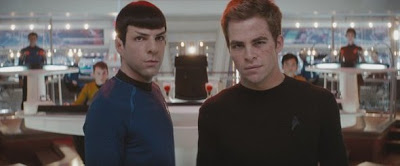
Kirk's story is of how THIS rebellious punk becomes THAT Starship Captain. It's Campbell's Hero's Journey once again and the biggest flaw could've been it's sheer unimaginability. Kirk has always seemed to be a self righteous space cowboy, a smirking two fisted George W. Bush knocking about the universe in his brash way and indulging in his preference for women of color-especially shades of green and blue-whenever possible.


Having walked onto TV screens fully formed, it seems impossible to imagine Kirk ever not being Kirk-that is, being a kid. But Abrams goes ahead and shows us some infant from General Casting and what appears to be another Culkin-bot as younger versions of Kirk. These aren't very convincing but this is where Abrams is getting better as a filmmaker. If you go fast enough, a good filmmaker can make you forget things like Indiana Jones being dragged underwater for miles lashed to a U-Boat. (See Raiders of the Lost Ark). As Hitchcock once said to a crew member looking for logic in the directionally illogical North By Northwest, "Don't be droll, dear boy."


Droll is the last thing Abrams ever wants to be and as a self sworn student of Movie Brats like Spielberg and Lucas he knows the power that mythic stories can hold over audiences. After Kirk gets into a barroom brawl with some Starfleet goons, he meets Captain Pike (Bruce Greenwood) who lectures him on making something of his life. Pike encourages him to join the Starfleet Academy and challenges him to do better than his father who once was Captain for 13 minutes and died saving the lives of 800 men and women including Kirk's mother and Kirk himself. This is a moment out of John Ford or Howard Hawks, a classic moment of mythic storytelling in which the young man, having refused the call to heroism his whole life, is made to confront his own destiny. Abrams follows this scene with one featuring Kirk riding his motorcycle alone into a field as the sun rises at dawn. A young man contemplating his future in much the same way as Luke Skywalker in that other Star film that Abrams obviously loves. Abrams knows well that if audiences can buy this moment, then they will go along willingly with this young man on his adventure which will also be their adventure as his choices reflect their own choices.

The most startling thing about this new TREK is how it avoids being incredibly AWFUL. If you think about it, there is no reason that this should ever be good or even great as it is. Trek has long entered the realm of parody and since the characters are so identified with the actors who played them, any attempt to step into those roles should seem like the worst of high school theater.


So, the real trick here is perhaps not pulled off by the writers or the director per se but by the cast. Somehow Chris Pine, the son of CHIPS actor Robert Pine and future winner of a Matt Damon look-a-like contest, is able to invoke the character of Kirk without EVER reminding you of the actor who made the role his own-William Shatner. There's not one iota of mimicry from Pine but at the same time you have no doubt that this man will become the Captain we know and love. Pine is good at looking smart when he behaves recklessly and maybe this is where his Damon-ness is most helpful. Jason Bourne operates as much from instinct as intellect and this is one of the strengths Pine brings to the role.

Zachary Quinto also makes the role of Spock his own and he has the uneviable task of having to actually share screen time with the real Spock-Leonard Nimoy. Quinto's Spock is still dealing with his emotions in a more raw way and the actor seems to channel as much of the classic Spock as the slightly unfamiliar one from the original pilot The Cage in which Spock was somewhat more emotional. Here Spock seems quite open to the shows of affection from Uhura (Zoe Saldana) and inclined to lose his temper when baited by Kirk.

The rest of the cast works extraordinarilly well in their respective roles, each taking a slightly different tactic in making the roles their own. Karl Urban steals many scenes with his near pitch perfect mimicry of DeForest Kelly's very particular voice and speech patterns. Along with Anton Yelchin's "V" challenged Chekhov, Bones is a character almost completely defined by the way he speaks-Urban's achievement is to do this without resorting to cariacature. Yelchin is primarily comic relief but the actor captures Chekhov's youth and is able to display his quirky intelligence in several scenes. One of the strengths of Orci and Kurtzman's script is the way they give each character a turn onscreen in the middle of the action to contribute something of their own. Sulu is known for his fencing so here he gets to best some Romulans with his saber and even save Kirk. Simon Pegg as Scotty is Simon Pegg with a Scottish accent but this is exactly right. He gets to beam his shipmates all over the place with the kind of professionalism James Doohan would approve of. Zoe Saldana is able to take the 60s Uhura and take away the issue of color. This Uhura is simply a valued member of the team, strong in her convictions but without losing her sensitivity to feelings, particularly those of Mr. Spock.


A note must be made of Bruce Greenwood's very strong performance as Captain Christopher Pike and of Eric Bana's choices as Nero. Greenwood's role may seem throwaway but it's of great importance to the story in actuality. Pike HAS to immediately evoke the honor and courage that that command requires. It is Pike whose prescence onscreen is the example set for Kirk and for us to understand what defines this duty and responsibility. Without an actor of quiet strength in this role, these ideas would merely be abstract instead of immediate.

Bana is a really good actor himself. Watch five seconds of Chopper followed by Munich and most would be instantly convinced. But his performance as Nero is perhaps too psychologically credible for a Star Trek film. The script doesn't help him here as Nero isn't given any more dimensions outside of his thirst for revenge. Bana gets the intensity just right but not the size. It's certainly good enough for the film and never hurts the storytelling but there is little of the Shakespearian quality needed for these Trek villains. Bana needed to keep the intensity but broaden the range of his performance a bit. Maybe this is where Shatner could've come in to participate. He could've easily coached Bana in how to get big without losing the plot.

Production wise, the film is damn near faultless. We've reached the zenith of special effects now where the painted and the photographed have lost their dividing lines. The sound mix is simply stunning. It's the work of Ben Burtt whose work on the Star Wars films defined the modern space epic. There are moments where the mix achieves poetry-as when Kirk and Sulu "spacedive" into the atmosphere of Planet Vulcan and the sound is cut off-leaving the dead silence of space and just the faint sound of breathing.

The sets and costumes are a wonderful evocation of the original '60s look but just tweaked enough to lose the camp value and become believable. Abrams then does something very smart with the excellent effects, sets and costumes-He ignores them. Never does the camera dwell on anything for its own good-every shot is there to further the story, nothing more. The result of this is a kind of space realism-we see things that look complex in the background and this helps us believe in the world of the story.

The biggest letdown is the score by the usually fantastic Michael Giacchino. There's nothing wrong with the scoring of the action pieces in the film, these are superbly done. What the film lacks is a strong and thrilling theme to get the film off to a big start when the STAR TREK title fills the screen. What we get is most underwhelming and remains underwhelming in other "big" moments in the film such as the reveal of the Starship Enterprise for the first time. It's a serviceable score but perhaps a bit too cerebral for its own good. What's missing is the guts of it. The big, powerful sound that Jerry Goldsmith used to bring to these films or James Horner's driving war themes in The Wrath of Khan. That said, there is great wit with which Alexander Courage's original theme is brought in at the end and Giacchino adapts it wonderfully with some very nice percussion.


Where Abrams still has a way to go to match his idols is in his staging. There is a lack of economy in some of his visual storytelling that would be effortless for Spielberg, for example. Where Spielberg can make a scene "sing" with a single tracking shot and downward tilt, Abrams still resorts to the scissors and breaks the action down into tiny pieces. A cut from one close-up to another close-up is a lot easier to shoot than to create more complex blocking with actor and camera and with the foreground and background. Still, this is only Abrams' second feature film not counting his work on the pilots of Alias and Lost. I'm sure he'll learn fast and soon his work will go where no man has gone before. Or something like that.

Wednesday, April 22, 2009

FRINGE: "Bad Dreams"

An Idiot Box Review by Brian Holcomb

So last night's episode "Bad Dreams" was the work of writer and debuting director Akiva Goldsman. This is the man behind the worst Batman script ever written, Batman and Robin. He also won an Academy Award for the worst script ever to be nominated for an Academy Award, A Beautiful Mind. So, one can say that expectations were quite low, lower in fact than those for many of the episodes of this still wet behind the ears series. But this turned out to be a pleasant surprise, probably the best episode yet.


Olivia ( Anna Torv) is having terrible nightmares in which she sees herself killing people. At least that's what she thinks she's doing when she dreams of pushing a young mother off a subway platform to be crushed by the incoming train. Of course, the dream has occurred in real life-in Grand Central Station in NYC-but the woman is seen on the security cam to just jump off the platform by herself, leaving her child in her stroller to witness the horrible event.

The Fringe team gets together to help Olivia solve her problem which turns out to be more complex than the usual "seeing through the eyes of the killer" trope expected. It turns out to be more of a "feeling what the killer is feeling" experience and is directly connected to the series' developing mytharc involving the US government's secret drug testing on children. Like much of Abrams' other work, the central concept may be derivative (in this case a twist on Cronenberg's Scanners) but the end product swallows up ideas at such a prodigious rate that it becomes less about what idea came from where than in how many of these ideas can be consumed in one sitting as one twist gives way to the next. Where Chris Carter cherry picked one classic horror-sci-fi movie idea at a time for each episode of The X-files, Fringe has no problem starting with a scene that looks to be an homage to Brian DePalma's homage to Battleship Potemkin in The Untouchables and ending with a final act that's a much more effective version of M. Night Shyamalan's endless and lame The Happening.

It's a tightly crafted little story that weaves its "monster of the week" very well within its bigger serial story. We learn more about Olivia's past and the secret that Walter (John Noble) is holding from her. We get some more foreshadowing of a romance between Olivia and Peter (Joshua Jackson). As in all the episodes thus far, there's always some eruption of strangeness or quirkiness that suggests a madman hiding among the writing staff. This week we get a surprising moment of Torv kissing a female stripper while in a hypnotic trance and her "experiencing" the male killer's orgasm following intercourse. The show ends with an old videotape that Walter digs up featuring a young girl in what appears to be a cruel experiment. Offscreen a sinister and gravelly voiced scientist can be heard giving Walter instructions. I wonder who this could be...

Friday, April 17, 2009

THE DESCENT Film Review


by Brian Holcomb

Wow. This mediocre and very derivative British horror movie has finally beached itself onto our shores riding a massive tsunami sized wave of online hype and hope. It's really nothing more than your run of the mill "old dark house" plot, with a group of young women who get lost in some caves instead of a house or a spaceship or a summer camp or the outback and are picked off one by one by some creatures who look like relatives of Gollum from "The Lord of the Rings". These underground dwellers may have once been human but have since evolved to live and hunt in total darkness. And that's about it.

Technically well made, writer-director Neil Marshall has obviously kept his DVD player spinning for days studying all of the classics and simply taking wholesale everything he needed like a Vanilla Ice "Under Pressure". But the elements he's Frankensteined together do not cohere into anything resembling a good story, instead seeming like an anthology of classic horror riffs-a kind of "Horror Movies for Dummies" primer.

Which makes it all the more bizarre is that it's the horror film fans themselves that have hyped this movie up on the net.When false hype is fed by desperate hope the results are insane blurbs like, "The greatest horror film of the last 10 years" or "The best cave dwelling mutant horror movie since 'The Mole People'!". It only demonstrates how bad the horror genre has become, that fans will go into orgasmic exhaltations over almost any movie that will risk an R-rating in the US multiplex market.

The true horror lies in the fact that Marshall seems to have real talent as a film director and could actually make some authentic horror classics if given better source material. The material provided here is paper thin: After a tragic prologue lifted from the screenplay structures of "The Changeling" "Don't Look Now" and "Dead Calm", "The Descent" settles into it's main narrative of six young ladies who decide to reclaim a sense of youthful danger in their responsible adult lives by going on a caving expedition in the Appalachian mountains. However, one of them, the American, Juno, decides to lead them to an unmapped and far riskier cave without their knowledge to increase the danger and the excitement. This, of course, proves to be the classic "really bad idea" and a few intense arguments, suspenseful traps and cave-ins later, the horror begins-photographed in scenes so dark they look as though they could've been shot in your basement with the lights off.

There are several quite capably directed jump out of your seat moments, but these all appear quite cheap when you try and follow the logic of the storyline which soon fades into the darkness. A horror film meant to be a surreal fever dream is one thing;"Phantasm" and "Suspiria" never intend to make conventional sense and we're never annoyed. This movie, however, wants to be taken seriously on some level as a real narrative, with some effort to display a mini morality play as well between several of the characters. When the movie works, it ditches the tiresome character material and focuses on the "haunted house" styled shock machine. Marshall knows that these old movie tricks still work and does a quite reasonable job of playing with the whole "now you see me,now you don't" cinematic game. For a short while at least, you feel as though you are watching the genuine article: a new cult classic horror film. But this is soon swept away amid a series of shots and plot turns that appear to be an homage to classic horror cinema.

This "genuine article" turns out to be a Xerox of a Xerox even using a second generation dub of the Ennio Morricone soundtrack from John Carpenter's "The Thing". If we can agree for the moment that "homage" is actually French for "rip-off", that would seem to explain, finally, the appeal of this over-hyped flick to many tired fans. For what is more gratifying to a life long horror movie fan than to watch a movie which is a kind of 90 minute shout out to them. "Hey, man, that's the helicopter shot from 'The Shining'", "Bet you dudes pick up on the reference to 'Apocalypse Now'!", "...the arm is from 'Carrie'", "...or maybe it's the hand in 'Deliverance'","It's definitely the broken leg from 'Deliverance'", "Everything from 'Alien' and 'Aliens'?" We could go on, but why? Yes, Neil Marshall and I like alot of the same movies. I own all of those movies on DVD myself. I just don't feel the urge to do my Karaoke version of them for the fanboys. Especially if I possessed the technical skills of Marshall who perhaps one day will make the genuine article he so admires, creating new classic images and moments that others will feel inspired to copy- beginning the whole cycle anew.

KINETOFILM SCORE: 2.5/5

Tuesday, April 14, 2009

The ANTI-CHRIST is Coming!


Lars von Trier's Antichrist - Official Trailer from Zentropa on Vimeo.

“I would like to invite you for a tiny glimpse behind the curtain, a glimpse into the dark world of my imagination: into the nature of my fears, into the nature of Antichrist.” LARS VON TRIER

Well, if that doesn't sound just like the opening of Garth Marenghi's Darkplace! Like Werner Herzog, It's ALWAYS hard to tell if Von Trier is kidding.


It's been awhile since we've heard from Von Trier and this film has certainly had its production troubles. But from the looks of it, it seems that Von Trier has crafted a film somewhat closer in style to his early works like The Element of Crime than the dogme and pseudo-dogme approach taken from The Kingdom onward. It also reminds me of Ingmar Bergman's Hour of the Wolf in its mix of isolation, psychodrama, and surrealistic imagery.

But that remains to be seen...

This is the plot as offered in a press release from Zentropa: A couple lose their little son, and the wife subsequently suffers from terrible anxiety attacks. Her husband is a therapist, and in spite of warnings not to treat people with whom you have close relations, they begin to tackle her fears together, and in the place where her anxiety is strongest: Eden, a deserted cabin in the woods.

The tough therapeutic struggle develops into a battle of the sexes. Her fears inhabit them both, and even he is not exempt from experiencing the merciless evil of nature. Natural brutality takes over and his cool reason is rendered futile. The evil in her runs wild.

Monday, April 13, 2009

HARPER'S ISLAND TV Review


Harper's Island is a gimmick show in the grand but bargain-budget tradition of master showman William Castle and his reality-TV bastard stepchild Mark Burnett. It's best described as And Then There Were None Because I Know What You Did Last Summer When We Were Survivors, but that was probably too long a title to be marketable. The show has been promoted as a "Mystery Event," which is CBS's way of saying it's a miniseries with a conclusive ending—in 13 weeks, to be exact. This is a rarity amid the current vogue for never-ending serials with no hope of a satisfying resolution. For better or worse, Harper's Island will come to a close in the dog days of summer revealing the identity of its mystery killer and answering the age old question, "Who Will Survive"

Survivor was definitely the inspiration for this fictional show's central gimmick. Each week, at least one of the wedding party guests on the isolated titular island will be killed off and Jeff Probst will be on hand to put out their cigars. Not really. But the show's biggest flaw is that it's a gimmick show that doesn't effectively exploit its gimmicky nature. It would be one thing if the script made a real attempt at strong characterizations and a compelling mystery, but based on the sketchy first episode, Friday the 13th Part 3D was more complex and Fred Walton's April Fool's Day much wittier. Read the rest of this review at SLANT MAGAZINE

Saturday, March 28, 2009

QUANTUM OF SOLACE

A Review by Brian Holcomb

For the first time since 1971's Diamonds Are Forever, a new Bond film begins pretty much where the last one left off: With the superspy going after the men who killed the woman he loved. This time, though, it's probably only about 5 minutes after the closing frames of Casino Royale which finds 007 (Daniel Craig) racing his Aston-Martin around the dangerous curves of a Monte Carlo mountain road while being pursued by 2,4 or 6 other reckless vehicles. I cannot actually be sure since the editing is so choppy in this Nouvelle Bourne Again style that pretty soon it looks as though we'll be seeing Craig drive the car right off the sprocket holes a'la Daffy Duck.

Marc Forster Is Going To Kick Your Ass

Out of his usual indie drama element, it's obvious that director Marc Forster (Monster's Ball, Finding Neverland) wants to prove his action movie mettle by starting the show off with a bang and he definitely gets the heart racing. But he also begins to seriously tax the very persistence of vision which allows cinema to operate by editing the scene beyond all possible coherence. NOTE TO FUTURE BOND DIRECTORS (and Paul Greengrasshole): A flurry of abstract motion will NEVER equal the excitement of an action scene where the audience can see the geography and clearly understand the stakes facing the hero. An action film is only interesting when it engages the audience in the hero's problems. Look at Steve McQueen in The Great Escape and Bullitt for two examples of character driven action. We want to see STEVE get away with it. Not some random stuntman. Look at the classics of action cinema and you'll see that CONFUSION is never the desired result. But I guess it's just easier to set up 137 cameras to film the action from every conceivable angle and hope for the best in the cutting room. C'mon, only the lame refuse to PRE-VISUALIZE. Here ends the action film soapbox which needs to be opened every time someone makes an action film these days.


No matter-Bond gets away from his pursuers by editing himself subliminally between the frames and after an awfully dissonant Jack Black-Alicia Keys number, the film never looks back. Someone at the Broccoli 007 Factory (AKA Universal Imports, Inc.) must've gotten the notes from ADD sufferers that Casino Royale was lacking in the action department because this entry makes up for it by lathering on the set pieces without regard to any kind of storytelling. The problem is that this film has more plot than 10 Bonds put together and a script that was obviously written around action scenes that were shot before the script was done. They are all clumsily motivated and inserted into this collage editing project.

The plot has something or other to do with a US backed villain (Mathieu Amalric as Roman Polanski) who poses as a liberal environmentalist named Dominic GREENE of all things (this has to be the work of the very literal minded Paul Haggis) but who really plans on stealing the water supply of an entire nation in order to control it's financial "flow". It's like Chinatown in the Middle East and that may be why the whole thing plays as a big yawn. What works in an adult detective story is too much for the comic book world of James Bond no matter how much it wants to ape the Bourne films.

Any gains made by shaking up the Bond formula in the excellent Royale are quickly tossed aside as Quantum returns the series to it's bread and butter and even redesigns SPECTRE for the 21rst century. That, I completely understand. A Bond movie in the real world would take the absurd and make it outlandish. No one wants to watch Bond chase after Osama Bin Laden and switch off his dialysis machine with a bad one liner. On second thought, maybe that would be great? In any case, the new and improved SPECTRE is called QUANTUM and this is easily the best idea for the series as a whole since Bond will have to spend film after film working his way up the ladder to find the man behind the man as it were (I'm sure it'll end up being Woody Allen). This leads to the best sequence in the film, by the way, as Bond forces a series of QUANTUM members to out themselves while attending the opera in their establishment disguises. Forster ALMOSTS gets this scene right, before he trips over his own erect penis while masturbating for deeper meanings. (Forster is no John Boorman, that's for sure, and this isn't Point Blank even when it is...)

There's a lot of stuff that seems to come from the mouth of Paul Haggis here and there. Stuff about the CIA being a-holes dealing with other other a-holes abroad and breaking deals without any moral code. A world lifted form multiple viewings of Syriana and positioning Bond as an enemy of the United States and its corrupt business interests. But since this Bond seems to be beyond morality himself, this isn't exactly a strong theme. Putting a Chandler-esque hero WITH a strong sense of right and wrong among the denizens of the underworld IS a strong story and would allow for stronger thematic points to be made without resorting to editorializing dialogue.

Oh, there are some girls in it, by the way. We're back with the Bond Bimbo formula in which GIRL#1 sleeps with Bond and then ends up as a sacrificial lamb for Bond to get angry about. As though Bond isn't already PISSED OFF beyond repair in the beginning of this film. He gets even more PISSED when he finds the naive Strawberry Fields (Gemma Arterton) having been killed by someone who probably saw Goldfinger once.


GIRL#2 (Olga Kurylenko) is the REVENGE GIRL archetype. She's a mirror to Bond's desire for vengeance if you want to give the screenplay this kind of credit. Bond doesn't get to sleep with her and maybe that's why she survives.

There's a lot of action in this movie. Boat action, car action, gun action, bedroom action. But it's all been reduced to the level of porn in that the audience is given nothing human to engage with between the action. The audience I saw the film with began immediately to text and talk to their friends whenever the action let up and didn't stop until the action picked up again. Now, this could be seen as the phillistine youth showing their true colors. But I don't think so. I've seen many films in which audiences of similar ages were totally spellbound by a gripping story or situation. I think they saw through the film's BS and realized that this wasn't a complete movie but rather a series of DVD chapter stops. They were merely skipping the boring parts.

But you know, a lot of this griping is just silly, right? It's a Bond film and Bond films have their own scale. This one is definitely better than The Man with the Golden Gun but not nearly as good as Goldeneye to keep it within the gold scale. Daniel Craig is a great Bond. He is the best Bond since Sean Connery. (Actually, he may even be better than Connery but since he arrived late he will have to wait in line.) He's clearly come to chew gum and kick some ass and he's all out of gum (©John Carpenter ,1988). He looks tough in the fight scenes and cool as hell in a tux. Craig, alone, holds the movie together whenever it threatens to completely self-destruct. I just wish Forster let us see more of him.

Thursday, March 26, 2009

RACHEL GETTING MARRIED


It has become somewhat fashionable to confuse nihilism with realism and to credit shallow filmmakers with depth merely because their themes are resoundingly negative. It's a cynical conceit which equates hope with naivete. Jonathan Demme has often been attacked as naive for the supposed la-la land of liberalness he depicts onscreen. Blacks, Whites, Hispanics, Asians, Gays, Straights, Bush, Obama; everyone is invited to his Starship Enterprise with open arms. The truth lies less in Demme's perceived naivete than in the childish cynicism of his critics. It's cynical to believe that people can never see the humanity in others beyond their social or cultural differences. Demme has never made a film in which these differences were ignored, in fact, they are most often celebrated. Not since the great Jean Renoir has there been a filmmaker more inclined to allow everyone to "have their reasons." In Demme's cinematic world, there are no heroes, no villains, no simple right or wrong and there is nothing naive about that. Amidst the worst of human impulses and self destructiveness, Demme always portrays life as hopeful - not some Capra-esque nirvana of love and redemption but as a tough world full of complex choices and always with the unshakeable conviction that life does, indeed, go on. Even Hannibal Lector at the end of Demme's The Silence of the Lambs is allowed to have an old friend for dinner and the hope of a new life somewhere far from the grip of the FBI.

Rachel Getting Married, Demme's latest film, is like a digest for everything he has stood for as a filmmaker since 1974's women-in-prison classic Caged Heat. In truth, the film often seems less like an actual narrative than a kind of Demme art happening. His sweeping and very democratic visual style seems to have been fused with the ideas behind the Danish Dogme movement and the all inclusive collaborative cinematic murals of Robert Altman. The story is simplicity itself: On a weekend pass from a rehab facility, recovering addict Kym (Anne Hathaway) comes home to attend her sister Rachel's (Rosemarie DeWitt) wedding and is very much aware that all eyes are on her from the instant she's picked up. Her father Paul (Bill Irwin) is way too overprotective, while her sister Rachel seems to want her to vanish, having picked her best friend Emma (Anisa George) over her as maid of honor. But neither of them is a match for her mother, Abby (Debra Winger) whose distance from her children is rivaled only by that of Mary-Tyler Moore in Ordinary People...

To read the rest of this review click HERE

Saturday, March 21, 2009

SIX FILMS TO KEEP YOU AWAKE


A DVD Review by Brian Holcomb

Spain isn't exactly the first country to come to mind when discussing the classics of European horror. England probably comes first with Hammer Films and directors like Terence Fisher and Michael Reeves, followed very quickly by Italy with genre auteurs like Mario Bava, Ricardo Freda, and Dario Argento. Joining the English gothic and the Italian giallo, we could even add the "Krimi" to the list and toss Germany into the mix before Spain. After all, Germany was where the genre really began, in the 1920s with masterpieces like Nosferatu and The Cabinet of Dr. Caligari both providing inspiration for decades of American horror films. But this categorization doesn't account for Spain's own contributions to the genre, no less fascinating for not being more influential. Most of this is due to the fact that the Spanish horror genre is largely eclectic, resulting in no clearly defined waves like the giallo in Italy. From the dreamy loopiness and sometimes simply loopy films of cult favorite Jesus Franco to Paul Naschy's more classical tales of tragic werewolf Waldermar Daninsky, Spanish horror is defined by being ill defined and sometimes generically spliced.

From Amando De Ossorio's Blind Dead series and Jorge Grau'sThe Living Dead at the Manchester Morgue which were designed to cash in on the wave of Romero's Night of the Living Dead to Alejandro Amenabar's Tesis with it's slick American thriller style, Spanish horror filmmakers have often had an eye on the international market. Which brings us to the series of films under review here, six films by six distinctive filmmakers from Spain's past, present, and future of genre filmmaking. As Spain's answer to the American Masters of Horror series, Six Films to Keep You Awake is yet another attempt to sell a series of modestly budgeted genre films to the international market . Produced for Spanish TV, the series is an update of a classic '60s program also called "Films to Keep You Awake".

Taken as a whole, the series of films are a fascinating look at the state of contemporary Spanish horror. Individually, however, the films fall victim to much of the same problems as their Masters of Horror brethren in that the near feature length is both too long and too short to be effective dramatically. The best of the bunch is director Alex de la Iglesia's ( El Crimen Perfecto) The Baby's Room. If you rent or buy this DVD set-start with this one.

Monday, March 16, 2009

STANLEY KUBRICK'S XANADU

Last night the Sundance Channel ran the fascinating documentary by Jon Ronson, Stanley Kubrick's Boxes which was a fine, though far too brief, look at the many thousands of boxes Mr. K kept in storage at his home in England. These boxes contained vast amounts of material, all carefully catalogued and organized, pertaining to all facets of the man's career and life.

It's strange that this private man of whom so much gossip ranged regarding his lunacy and hermitage can be seen so nakedly through his calculated filing. The image one gets is not one of a man OBSESSED but of a man of great intellectual curiosity and method. An obsessed man would merely seem eccentric and quirky in his desire to control the world around him. Kubrick went round that bend and into something far closer to a scientist of the physical universe. This was a man who questioned everything from the font on a movie poster, to the size of his newspaper ads, to the kind of ink best used for writing and the construction of these archive boxes themselves. It appears Mr. K was frustrated with the way the tops of the boxes worked and was intent on finding a design that would allow the lids to sit securely but loose enough to slide off easily. It's most telling that the company constructing the boxes left a random note regarding the box construction that supposedly read, "Fussy customer".

Kubrick didn't think wanting things to work the right way to be fussy and this is the same attention to detail that went into all of his films and which makes them so very unique to this day. He believed that either you care or you don't, there's no in between. That kind of pride and dedication to one's work is something I must say I admire greatly.

I thought that Ronson made a fascinating film, particularly when he played detective and hunted down some of the people who sent Kubrick letters which the director filed as "crank" letters.

If you missed it, here it is:


Or you can find the entire thing on google video:
HERE

Tuesday, March 10, 2009

RAIDERS OF THE LOST ARK: THE LOST TAPES


If you head over to MYSTERY MAN ON FILM you'll be in for a real treat. Well, that's kind of an understatement. This may be one of the true Holy Grails for those of us who are fascinated by the creative process. There's a link to a PDF available for download there, a 126 page transcript of the original story conferences for Raiders of the Lost Ark! From January 23, 1978 thru January 27, 1978, George Lucas, Steven Spielberg, and Lawrence Kasdan spent 9 hours a day for 5 days hashing out the story and characters for their new film and it's all here. I have NO idea how this was allowed to escape and I sincerely doubt that the very controlling Lucas and Spielberg approve of it. But since it's available we now can observe the process with which each idea is suggested, tested, spun over and either developed or thrown away.

It's interesting to see how much of it is dominated by Lucas and how quickly he shifts his roles from Writer to Producer when he dictates that one of Spielberg's ideas is going to "cost another million dollars" and should be dropped. They are confused for a while as to what kind of heroine to put in the picture until Kasdan suggests that Indy had an affair with his mentor's daughter years ago and now she's grown up. They are way too excited to make her very underage and initially they want her to be as young as 10 or 12! But Lucas quickly becomes more conservative on this issue and says that they should make her 15, because at 16 or 17 it's no longer interesting. Lucas seems very concerned with keeping Indy cool but still a role model for children. I am sure he was thinking about his future deals with Kenner for the toys.

There is a constant discussion and argument over budget versus production value. Lots of talk about Hong Kong mogul Run Run Shaw and the use of stock footage. Spielberg seems to want crowds even if he has to steal the shots in Bombay. Lucas is more interested in making great stunts over the spectacle and thinks the money is best spent this way. It's interesting to see how Lucas, whose dime this was to be made on, is watching over the shop while Spielberg who had just come off a lot of bad press for budget overruns on the mega-bomb 1941 is more than happy to spend whatever necessary to make a great movie. I really think that the tug of war between these two, balanced by the story smarts of Kasdan really clicked, at least this one time.

It is fascinating to see how much Lucas seemed to understand the basics of storytelling at the time, basics which he seems to have lost today in the deserts of Tunisia. Here's a sample form the opening pages of the transcript which show just how much he seems to have understood about storytelling: (G=George Lucas, S=Steven Spielberg, L=Lawrence Kasdan)

G — We'll just talk general ideas, what the concept of
it was. Then I'll get down to going specifically through
the story. Then we will actually get to where we can
start talking down scenes, in the end I want to end up
with a list of scenes. And the way I work generally is
I figure a code, a general measuring stick perameter.
I can either come up with thirty scenes or sixty scenes
depending on which scale you, want to work on. A thirty
scene thing means that each scene is going to be around
four pages long. A sixty one means that every scene is
going to run twenty pages long. (?) It depends on, part
of it is the... (short gap in the tape) knock some of
these out, and this doesn't work out the way we thought
it would. You can move things around, but it generally
gives you an idea, assuming that what we really want at
the end of all this is a hundred and twenty page script,
or less. But that's where we really want to go. Then
we figure out vaguely what the pace of, how fast it's
going to move and how we're going to do it. I have a
tendency to work rather mathematically about all this stuff.
I found it easier and it does lay things out. Especially
a thing like this. The basic premise is that it's sort
of a serialesque kind of movie. Meaning that there are
certain things that have to continue to happen. It's
also basically an action piece, for the most part. We
want to keep things interspaced and at the same time
build it. As I build this up, you'll see it's done
vaguely by the numbers.

Generally, the concept is a serial idea. Done like the
Republic serials. As a thirties serial. Which is where
a lot of stuff comes from anyway. One of the main ideas
was to have, depending on whether it would be every ten
minutes or every twenty minutes, a sort of a cliffhanger
situation that we get our hero into. If it's every ten
minutes we do it twelve times. I think that may be a
little much. Six times is plenty.

S — And each cliffhanger is better than the one before.

G — That is the progression we have to do. It's hard
to come up with. The trouble with cliff hangers is, you
get somebody into something, you sort have to get them
out in a plausible way. A believable way, anyway.
That's another important concept of the movie — that it
be totally believable. It's a spaghetti western, only
it takes place in the thirties. Or it's James Bond and
it takes place in the thirties. Except James Bond tends
to get a little outrageous at times. We're going to take
the.unrealistic side of it off. and make it more like the
Clint Eastwood westerns.

G — The thing with this is, we want to make a very
believable character. We want him to be extremely good
at what he does, as is the Clint Eastwood character
or the James Bond character. James Bond and the man
with no name were very good at what they did. They
were very, fast with a gun. they were very slick, they
were very:professional. They were Supermen.

S — Like Mifune.

G — Yes, like Mifune. He's a real professional. He's
really good. And that is the key to the whole thing.
That's something you don't see that much anymore.

S — And one of the things that really helped Mifune in
all the Kurosawa movies is that he was always surrounded
by really inept characters, real silly buffoons, which
made him so much more majestic. If there are occasions
where he comes up against, not the arch-villian, but
the people around him shouldn't be the smartest...

G — Well, they shouldn't be buffoons. The one thing
we're going to do is make a very good period piece,
that is realistic and believable. A thirties movie in
the, even in the Sam Spade genre. Even in the Maltese
Falcon there were some pretty goofy characters, but
they were all pretty real in their own bizarre way.

S — Elijah Cook.

G-Elisha Cook might~not have"been-the brightest person"
in the world. In a way he was the buffoon of the piece,
but at the same time he was very dangerous and he was
very... They were strong characters. If we keep it
that mode of believability...

S — It's just like you don't put Lee Van Cleef as an
accomplice to... (garbled)

G — No, you put Eli Wallich.- Did you see "The Good, The
Bad And the Ugly"? The Eli Wallich character is a goofy
character, but at the same time he's very dangerous and
he's very funny and he's ... We can have that kind of
thing. The main thing is for him to be a super hero in
the best sense of the word, which is John Wayne, Clint
Eastwood, Sean Connery tradition of a man who we can all
look up to and say, "Now there's somebody who really
knows his job. He's really good at what he does and he's
a very dangerous person. But at the same time we're
putting him in the kind of Bogart mold, like "Treasure of
Sierra Madre" or ...

S — Or even the Clark Gable thing we talked about.

G — Yeah, the Clark Gable mold. The fact that he is slightly
scruffy. You don't know it until it happens.

Now, several aspects that we've discussed before: The image
of him which is the strongest image is the "Treasure Of
Sierra Madre" outfit, which is the khaki pants, he's
got the leather jacket, that sort of felt hat, and the
pistol and holster with a World War One sort of flap over
it. He's going into the jtingle carrying his gun. The
other thing we've added to him, which may be fun, is a
bull whip. That's really his trade mark. That's really
what he's good at. He has a pistol, and he's probably
very good at that, but at the same time he happens to be
very good with a bull whip. It's really more of a hobby
than anything else. Maybe he came from Montana, someplace,
and he... There are freaks who love bull whips. They just
do it all the time. It's a device that hasn't been used
in a long time.

S — You can knock somebody' s belt off and the guys pants
fall down.


Tellingly, Lucas doesn't seem to like this idea too much as it seems more broad than the rough and tumble adventure he has in mind(Which is exactly why I think RAIDERS stands tall above its more splatstickey sequels .) Flashforward to last summer and Crystal Skull is filled with this garbage (seemingly very much approved by the new Jar Jar mad Lucas), like Shia Lebouf swinging on vines a'la Tarzan following a horde of monkeys. Ugh.