Thursday, August 18, 2011
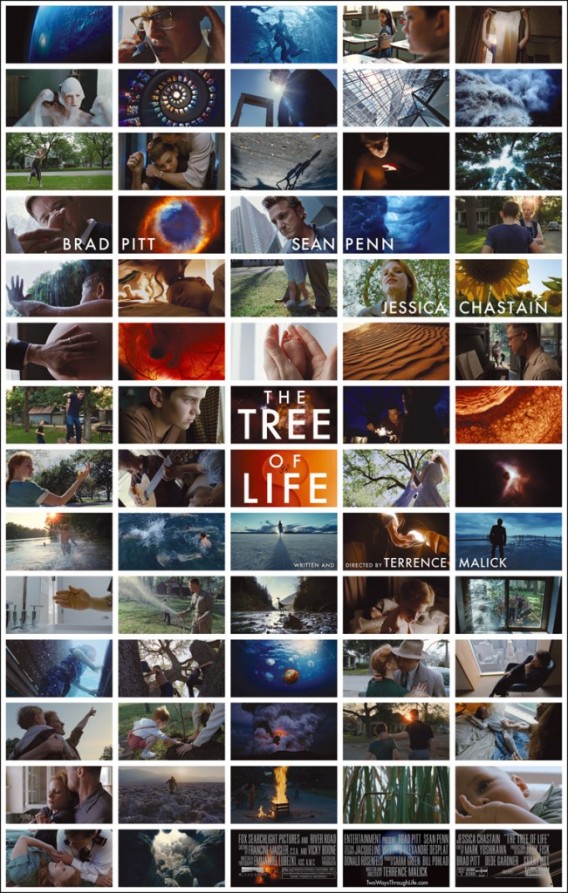
TREE OF LIFE Film Review
By Brian Holcomb
The only thing I can tell you about this movie is that it's less than meets the eye and that if you quickly scan all the images in the above poster and think about them for a minute you will have pretty much the same experience as you might by spending the 12 plus hours it takes to run in the theater.
Speaking of seeing it in the theater, I had the most amazing experience just buying a ticket to see this at my local multi-fauxartplex. Upon delivering the words "One for 'Tree of Life'" to the dazed box office attendant, I was immediately halted. She raised her hand as though she were a gypsy fortune teller warning me of imminent danger and began reciting some kind of prescripted statement.
Sounding like someone on a telethon reading a cue card, the girl said, "'Tree of Life' is an unusual film. It does not relate a standard narrative. If you find that 'Tree of Life' is not to your tastes or liking you have to return to this box office no later than 30 minutes after the start of the film in order to receive a refund. No refunds will be issued after the 30 minute limit."
It was the first time I have ever received a Surgeon's General warning about the dangers of watching a movie.
Malick needs to keep these films for his eyes only. This is the kind of film made to exhaust all patience. My patience has just run out writing about it.
Friday, January 28, 2011
The Girl Who Kicked The Hornet's Nest DVD Review
by Brian Holcomb
The third entry in Stieg Larsson's enormously successful series is perhaps the least thrilling but it's easily the most satisfying. For those who have spent two films suffering along with the almost cosmically tortured Lisbeth Salander (Noomi Rapace), The Girl Who Kicked The Hornet's Nest will be particularly cathartic. As a film it's about as pedestrian as the others in the series but as usual it is Larsson's storytelling talents and the near mythic Salander character that keeps us engaged.
When we last saw Lisbeth and the Millennium Magazine gang, the brilliant hacker was trying to kill her abusive father, a old and rotting Russian defector. Oh and defend herself against his hulking bodyguard Niedermann, a blonde weirdo who was genetically impervious to pain. (Oh, and he turned out to be her half-brother, too! The plot does thicken a bit here and there!)
To read the rest of this review at Cinemablend.com click HERE
Wednesday, January 19, 2011
AU RENDEZ-VOUS DE LA MORT JOYEUSE (1973) Film Review
by Brian Holcomb
KINETOFILM SCORE: 3.5/5
To call this very peculiar and original supernatural tale Buñuelian is doubly accurate. While it certainly captures the great surrealist filmmaker's sense of the mysterious within the mundane, it was also directed by an actual Buñuel, Juan Luis Buñuel, the master director's son and sometime assistant. The younger Buñuel had a tremendous hurdle to leap in order to establish his own directorial signature and I'm not sure if he ever really did. Jean Renoir had a similar situation as the son of the great impressionist painter but he, importantly, chose a different art form in order to create his own niche. Working in the same medium as his celebrated father, it was perhaps inevitable that Juan Buñuel would find his looming shadow difficult to escape . This was most obvious in his second film, "The Lady with Red Boots"(1977) which was filled with his father's trademarked jokes and familiar faces like Fernando Rey and Catherine Deneuve in the cast. While delightful in it's own right, that film was more like Buñuel "doing" a Buñuel . It was an accurate, studied facsimile. His first film, "Au Rendez-vous de la Mort Joyeuse" was far more original, spontaneous, and pure. A truly bizarre and disturbing horror film-black comedy that seems to have come much more naturally to the director.
The story is pretty standard but deceptively so: A family moves into a country estate and soon after are plagued by a series of paranormal events which seem to revolve around the teenaged daughter Sophie (Yasmine Dahm). Windows are smashed, furniture moves on it's own and ultimately a visiting friend is viciously attacked and nearly killed. Fleeing the house, they allow a TV crew to move in and attempt to solve the mystery. They do not.
As described, the plot sounds like any number of haunted house thrillers and narratively the film is, indeed, quite mundane. What's kept this movie on the fringes of cultdom, however, is that the filmmaking itself appears mundane and routine as well. There are no extreme long takes, unique and attention grabbing camera angles, or bizarre editing patterns. Visually, this looks no different from any early '70s television film but, once again, this is deceptively routine. A visual economy in line with the elder Buñuel's signature style which he always insisted was no style at all. This was true only in that having no style WAS his style. The economic staging, simple understated framings and consistently objective viewpoint provided the perfect vehicle for depicting his crazy content in an almost journalistic manner. Buñuel seems to have picked up much of this from the great French filmmaker Louis Feuillade, whose "Les Vampires" presents a similar swirl of insane events all photographed on location on the streets of WW1 Paris like some kind of twisted newsreel.
This was the basis of a certain strain of cinematic surrealism but in "Au Rendez-vous de la Mort Joyeuse" the younger Buñuel seems to have moved beyond his father's preference for constructing strings of shocking jokes in place of a narrative and gone back to the narrative as spectacle of Feuillade himself. The story is no longer merely a clothesline on which to hang a series of random vignettes but is actually the vehicle driving the movie itself. We not only watch to see what "will happen next", but to see just what in the hell COULD happen next as the events get stranger and stranger. The film has a hypnotic power that is not dream-like but rather dream-real. It's as though Frederick Wiseman was somehow sent into a madman's nightmare armed with a 16mm camera. There is a sense that anything can happen in this story, no matter how random, odd or inexplicable. What's most impressive, however, is the way these random and inexplicable events seem to occur naturally and out of some inner logic
At first, we are presented scenes in which the teenage daughter Sophie is seen carrying on in a very suggestive, enigmatic way with her parents and younger brother. Some of this is based on documented cases of poltergeist activity which often center on the trauma of an adolescent female entering adulthood. Sophie is seen to be at odds with her mother, possessive of her father, and completely dismissive of her younger brother's existence-which appears to be an annoyance at best. When the child complains of sleeping alone, he's placed into Sophie's room causing her to become irate. "I hate hearing people breathe. It's my room!" is her reaction.
One night, Sophie is seen observing with a mix of fascination and revulsion the sight of her parents making love. She slams the door on them to get their attention and storms off. Immediately following this, the windows all over the house begin shattering on cue. The image of Sophie standing in sillohuette at the end of a long hallway while a long line of windows shatter in front of her is one of the film's most powerful, both beautiful and disturbing at the same time. It's an image that almost seems too smart, too affected amidst the much more banal recording of daily events we've been subjected to thus far.
At this point in the story it still seems as though we are watching a rather ordinary case history of paranormal events. But it's the random that really defines the way the film unfolds and creates one of its most inspired ideas. In every haunted house thriller, believability is always stretched once the family realizes that the house is haunted. Why stay and face more terror? Lame narrative excuses are usually created in order to keep the family from just running off like they should. But here, they actually DO run off once the house goes haywire and only halfway through the movie!
Like Hitchcock did with "Psycho", Buñuel shifts gears from his main characters and introduces Perou (Jean-Pierre Darras ), a TV producer friend who presses Marc to allow him to send his crew to the house to see if they can record the phenomena on film. What follows is something that seems along the lines of later work like the BBC "Ghostwatch" or "The Blair Witch Project" as the viewpoint alternates between objective shots of the investigative crew and subjective shots from the point of view of a documentary camera. The focus shifts from Sophie and her family to the producer and his crew which includes a young Gerard Depardieu as a bearded and nervous soundman.
Bifurcated as it may seem, this half of the story is not a complete break from the first. Sophie shows up almost out of nowhere with her hair no longer in pigtails and wearing a very couture fur coat. She looks like the teen fashion model that actress Dahm really was at the time-Nabokov's nymphette. Her father shows up shortly after, but tellingly her mother never again appears in the film. It's as though Sophie has usurped her place in the household in some kind of mock-Freudian coup.
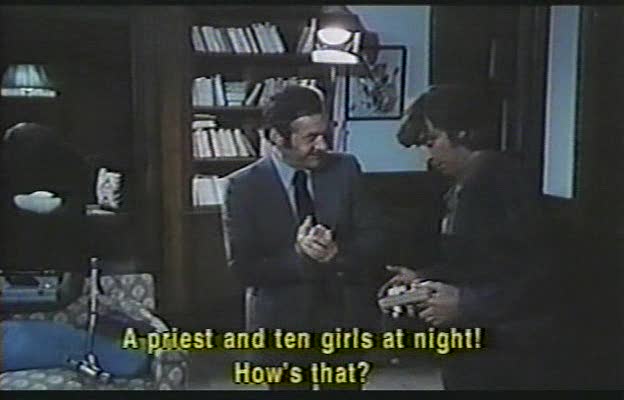
With her arrival things really get weird again. Everyone goes crazy almost immediately, Depardieu in particular. Preparing some homemade soup for dinner he suddenly feels compelled to place his hands into the boiling water. Which he does in a totally non-dramatic, matter-of-fact manner which makes it all the more hilarious and weird. After an eruption of vibrations and flashing lights the story looks to be settling into its new form as a paranormal investigation "thriller" in the vein of "The Haunting(1963)". But once again this new stasis is interrupted by the random: the sudden arrival of the local Vicar (Claude Dauphin) with his flock of young children. Never mind the "explanation" that the Vicar always brings the children to stay at the house for a night, they've now crashed this cinematic party. An elderly Priest and a rag-tag group of children who look like refugees from a touring production of Dickens' "Oliver Twist", they are allowed to stay the night and are immediately drawn into the general flow of the action.
What transpires during this final phase of the film is a series of oddball vignettes as the narrative gives way to a freefall of inexplicable events and images. It's at this point that the film reveals that it has been setting up certain symbols throughout which were meant to re-appear in the final act in some subconciously logical way. The elder Buñuel had a personal distaste for symbolism. He felt that it reduced the power of mystery to a kind of intellectual code-breaking which is why his early films in particular, like "L'Age D'Or", are filled with obvious symbols used in nonsensical ways in order to confuse the pretentious. Juan Buñuel seems to have broken from this influence as his use of symbols in "Au Rendez-vous de la Mort Joyeuse" seeks to evoke a more private and self contained point of reference. In a more Kubrickian way, he creates a series of enigmatic and repeated images which clearly mean SOME-thing. Exactly what is open to wide interpretation. In "2001: A Space Odyssey", Stanley Kubrick used the monoliths to visualize something intangible-the alien influence on human evolution and progress. In "Au Rendez-vous de la Mort Joyeuse", there is a filthy old rope that's discovered several times, once in the bed of the younger brother and also the sudden appearance of mounds of dirt. The dirt is first seen smeared all over the drawings of Sophie's father. Later, Perou finds himself being seduced in the dark by what appears to be Sophie but in a precursor to the book and film of "The Shining" she is revealed to be a frightening old hag. When his crew come running after hearing his screams of horror, they discover him writhing in the bed, covered with the same mysterious mound of dirt.
The filthy old rope returns at the very end. The final act of the movie is not unlike Mario Bava's "Bay of Blood" in its harsh depiction of self-serving humans doing whatever they must in order to save themselves. As several of the crew try to escape including the wounded Depardieu, each finds themselves falling prey to something inexplicable. As if to remind us of the Lewis Carroll influence on this weird tale of burgeoning female sexuality, Perou tries to make a run for it and basically falls into a rabbit hole: he takes two steps and falls through the floor of the living room into a bottomless old well. Inexplicably, it seems that two of the crew's vehicles have become rusted and overgrown with weeds. Depardieu escapes to the only vehicle left undamaged, the mini-van. The children pile in and he and the Vicar get into a desperate physical battle for the driver's seat, the Vicar banging on his wounded hands and Depardieu finally beating the old man down with a crowbar. But soon after Depardieu loses control of the vehicle crashing it into a clump of trees on the property. Inexplicably, Depardieu is suddenly attacked by the children themselves. They put a blanket over his head, bind his arms, and finally strangle him to death with the filthy old rope itself.
The film ends with Sophie and her father again, just like in the beginning, staring at the idyllic country house. The father says that the house should be burned to the ground. Sophie doesn't answer but her strange expression seems to suggest she knows that the trouble was never really with the house at all. She goes back inside alone to find her drawing of the house. She depicted it covered with ivy as that's how she wanted it to be. The film ends on a series of lap dissolves on the house, as it is slowly covered by the ivy as she wished.
"Au Rendez-vous de la Mort Joyeuse" is the kind of film that seems simple on the surface like Kubrick's film of "The Shining" but rewards multiple viewings as it becomes clear that there is much significance in the smallest of details. It's a creepy film in the tradition of "Let's Scare Jessica to Death" in which the fear is not from a direct physical threat but rather in the whispered suggestions just below the level of consciousness. One of the film's most amazingly ordinary and yet powerfully surreal scenes involves "two" Sophies seen dressing and undressing at the same time. Reflected in a mirror, we see Sophie dressed in her stylish fur coat and turtleneck sweater as she begins to slowly disrobe staring the whole time at her "innocent" self in the room, dressed in a nightgown and starting to put on the very turtleneck sweater and fur coat her doppelganger has removed. The power of this short and strange scene is enhanced in that there is no music or sound effects to be heard on the soundtrack at all. This is an extremely quiet film which features no scored music and only the most subtle of sound effects judiciously used. Much of the movie has the power of old home movies in which the only accompaniment was often the whirr of the projector which gave the mute people and world on the screen a secret life of its own. It creates the uncanny feeling of something both impossible and magical that just happened to be recorded from reality. An uncanny mood that could be called Buñuelian.
AU RENDEZ-VOUS DE LA MORT JOYEUSE(1973)France/Italy USA TITLE: EXPULSION OF THE DEVIL
Screenplay: Juan Luis Buñuel & Pierre-Jean Maintigneux
Director of Photography: Ghislain Cloquet
Director: Juan Luis Buñuel
Cast: Francoise Fabian (Francoise), Jean-Marc Bory (Marc), Yasmine Dahm (Sophie), Jean-Pierre Darras (Perou), Claude Dauphin (Father D'Aval), Michel Creton (Leroy), Gerard Depardieu (Beretti), Andre Weber (Kleber)
90 mins.
Monday, January 10, 2011
FREEBIE AND THE BEAN: RICHARD RUSH
This amazing film is finally available on DVD in the Warner Bros. "Made to Order" store. Look at that chase scene embedded above. It's fascinating. As well photographed and staged as The French Connection or Bullit but there's another layer going on in the loose improvisation between Arkin and Caan as well as the Godard influenced God's eye views of the action which make everything seem more absurd through the wider context. If you need a higher recommendation than my own, this was highly praised as a masterpiece by both Francois Truffaut and Stanley Kubrick. Those are two giant "Thumbs up!". More about this film later.
It can be ordered HERE
Friday, December 03, 2010
BLACK SWAN Film Review
The Black Shoes:
Or How Darren Aronofsky Became Trapped in a Powell-Polanski-Pressburger
by Brian Holcomb
Upon first glance Black Swan appears to be a psychological horror film about a ballerina who goes insane. But in reality it's a movie about a filmmaker who goes insane-in good ways and bad. Perhaps not the kind of madness that engulfs Nina Sayers (Natalie Portman) onscreen. No, director Darren Aronofsky has become spellbound with aesthetic perfection. He takes this simple and clearly MINIMAL story and directs the very life out of it, subjugating everything to a dictatorial design concept. The concept is ambitious and fully realized with all the tools at his talented disposal. Only the tools are much too large and clumsy to get the job done properly.
In terms of content, Black Swan is a potpourri of ideas, themes, characters and plot devices from a whole range of horror films (Carrie, Repulsion, Cat People, Jacob's Ladder) and backstage musicals (The Red Shoes, The Phantom of the Opera, Showgirls). You have the shy but ambitious young ingenue(Portman)who gets her big break when the Svengali-like Ballet director (Vincent Cassell) decides to replace the aging company star (Winona Ryder) in his new production of Tchaikovsky's "Swan Lake". The ingenue, Nina Sayers, is a kind of sheltered child woman who lives with her very protective stage mother (Barbara Hershey) in a small stuffed animal and pink walled adorned apartment in NYC. Mommie Dearest and daughter have a disturbing relationship in a private world of their own making. Nina not only has an eating disorder (quite cruelly mocked by her mother with a large celebratory cake) but a history of "scratching" as well-a problem significant enough that mom sometimes has to put protective mittens on her hands.
Of course, Nina has a few other issues as well-one of them being the fact that she's probably schizophrenic. Once cast in the coveted dual role of "white swan" and "black swan" (see where this is going?), it becomes clear that she has problems conveying the rage and sexuality needed for the role. She begins to see Lily (Mila Kunis) her "alternate", as competition. The carnal Lily is very suited to the role of the "black swan" and Nina's desperate desire to find that side within herself sends her into a spiraling descent from sanity.
You can already see how LITERAL the movie is just from the description. "White Swans", "Black Swans", Lily is made Nina's "alternate" and of course mirrors proliferate.
The film is also literally black and white. Not shot on black and white filmstock, the film is in color but more often than not the screen is divided into blacks and whites. Wardrobe, locations, set dressings etc. are all defined by this design choice. Initially the visual command is very admirable but instead of allowing us to immerse ourselves into his carefully crafted world, Aronofsky has to push it into our collective face. So much so that it begins to grate on the nerves as yet another scene is surrounded by this Yin/Yang symbolism.
The desire to control the tiniest detail onscreen comes very close to the obsessive-compulsive and it's not long before the director's bag of tricks becomes extremely obvious. Instead of allowing a scene to breathe or allowing for Portman's raw and fragile performance to emerge on its own, Aronofsky is almost compelled to throttle the movie with expressionist devices right out of the film that haunts this one the whole time, Michael Powell and Emeric Pressburger's nightmare fantasy The Red Shoes. In fact, there seems to be a stylistic collision going on throughout with Roman Polanski's trademark surrealistic realism being fused with the operatic ARTIFICE and theatricality of Powell-it's like oil and water. The story can be played either one way or the other but the two together work against the strengths of both. But with it's minimalist screenplay and realistic performances, the film should've been handled with more subtlety. The subtlety that uncharacteristically showed up in Aronofsky's last film, The Wrestler. That film allowed time to just watch Mickey Rourke's performance, to observe the process of his sport in a way this film does not do for ballet. Instead, Aronfsky's camera and scissors go into attention deficit overdrive and try to compensate for the minimalism with furioso-even going so far as to indulge in some really questionable CGI that makes the avian transformation also literal (Perhaps a brief shot of Nina seeing herself in a shadowy reflection would've been uncanny and frightening but what we get is very close to some cheap werewolf movie).He need not have worked so hard as his story was decent enough and his actors extremely able. What could've been something truly disturbing and memorable is reduced to an interesting, but failed experiment.
Nina Sayers is continually told that to play the black swan she must "let herself go", that true perfection can only come through the danger of spontaneity. Well, this could be advice Darren Aronofsky could take to heart.
KINETOFILM SCORE: 3/5
Thursday, October 21, 2010
ANTICHRIST Film Review
KINTETOFILM SCORE: 4/5
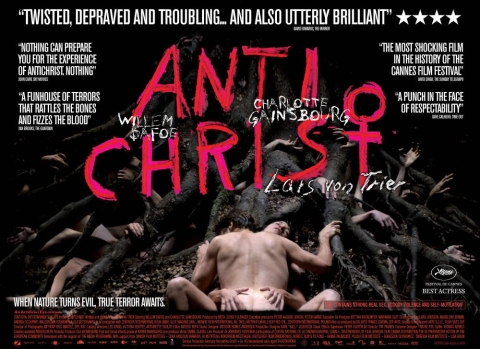
The phrase "WTF?"is pretty much the perfect Twitter-sized review for this film. Von Trier is a prankster at heart so any serious attempt to guess at WTF he had in mind with this Bergmanesque psycho-drama could just end up with the Danish auteur pulling your leg. Or worse some other more private part of your body. After seeing this film and its obsession with genital mayhem you'll get my drift.
Since its debut at the Cannes Film Festival, the film has received some wildly divergent reviews. That's because Your Mileage May Vary depending on how well acquainted you are with the cinema of Von Trier and transgressive art itself. This is a film that begins with a shot featuring penile penetration and then goes much farther from there.
Here's a helpful chart:
The only thing missing from that checklist are "Animals Who Say Unpleasant Things Like 'Chaos Reigns'" and "Willem Dafoe's Ass Is On Display More Than Once".
The film's plot sounds simple: Following the accidental death of their infant son, a Therapist (Dafoe) takes his wife (Charlotte Gainsbourg) to a cabin in the Seattle mountains in order to deal with her nearly overwhelming grief and guilt. Almost immediately upon their arrival, it seems as though some kind of force of nature intends on torturing them both mentally and physically. What happens as a result of this needs to be seen not described. Suffice it to say that it involves some of the most shocking and intense imagery you will see in a contemporary film. This film rivals Takashi Miike's Audition in the "I can feel that pain myself" department.
Charlotte Gainsbourg gives a fully committed madwoman performance that ranks right up there with Von Trier's other suffering/borderline insane childwomen like Bjork in Dancer in the Dark or Emily Watson in Breaking the Waves. She also wields a mean pair of scissors. Dafoe is excellent as usual and this is key to the film since it only contains two characters for its entire running time, with Dafoe actually appearing the be the rational one. The running time is fairly short for Von Trier-108 minutes-and yet the mental and physical torture is so intense it may feel endless to some. Some may never want to engage in sexual intercourse ever again.
Von Trier mixes his style up here, using some of his recent Dogme techniques of handheld cameras and intimate acting along with his earlier more flamboyantly visual work. The opening 10 minutes which cross cuts Dafoe and Gainsbourg performing some shower porn with the death of their child is shot in extreme slow motion and in silvery black and white. It looks like a slick commercial for DIOR. This is instantly followed by the handheld digital video Von Trier is more known for these days. Both are quite effective.
It's probably to the film's benefit that its meaning is so obtuse. With a forest called "Eden", nameless "He" and "She" characters and discussions of the evil inherent in nature the film is already dangerously close to student film pretension. Von Trier saves himself through his own sardonic sense of humor and the fact that he just moves on. All kinds of inexplicable events come to pass and they just pass on by without much fanfare at all. It's wonderfully surreal in that regard. In that respect, the Fox may have provided the best explanation of all: Chaos Reigns.
Sunday, September 26, 2010
BEST FIRST FILMS LIST
by Brian Holcomb
Since the OFCS (Online Film Critics Society) is compiling its Top 100 First Films list, I decided to publish my picks here for the Top 25:
1. Citizen Kane (Welles)
2. Knife in the Water (Polanski)
3. L'Age d'Or (Bunuel)
4. Eraserhead (Lynch)
5. Reservoir Dogs (Tarantino)
6. Breathless (Godard)
7. Blood Simple (Coens)
8. Badlands (Malick)
9. Repo Man (Cox)
10. Duel (Spielberg)
11.The Evil Dead (Raimi)
12. Mad Max (Miller)
13. Henry V (Branagh)
14. The Bird with the Crystal Plumage (Argento)
15. Thunderbolt and Lightfoot (Cimino)
16. The Maltese Falcon (Huston)
17. Murder a'la Mod (De Palma)
18. Night of the Living Dead (Romero)
19. The Duellists (Scott)
20. Targets (Bogdanovich)
21. Airplane (Zucker, Abrams, Zucker)
22. Night of the Hunter (Laughton)
23. This is Spinal Tap (DiBergi Reiner)
24. Bottle Rocket (Wes Anderson)
25. Hard Eight (Paul Thomas Anderson)
Saturday, September 25, 2010
CHLOE Film Review
by Brian Holcomb
Atom Egoyan occasionally tests the waters of the kind of Skinemax Cable movie he would be forced to make if his films weren't so critically acclaimed. Actually he may not be as critically acclaimed as I think. I seem to remember that Kevin Bacon Colin Firth movie being pretty savaged by the critics. But for the most part, he's pretty well liked and remains second only to David Cronenberg in my favorite Canadian filmmakers list. The list is short since I haven't watched too much of Canadian cinema. Sorry, Canada.
Anyway, this is a film about sex. About people who no longer have sex, people who have it all the time, people who pay for it or get paid for it, and basically how easy women think it is to get a man to do it. Which men will tell you is pretty easy. Especially after a few Molsons.(That's for you, Canada.)
The lead character isn't Chloe at all but really Julianne Moore. She plays a gynecologist who isn't getting any action or affection from her husband Liam Neeson at home. That's because their daughter was kidnapped by some Middle Eastern white slavery ring and Liam's out there busting heads trying to save her. Wait...that's another movie. In this one, Liam is more brains than brawn and teaches some really boring class about art. The students like him a lot, especially the female ones and he's been known to miss a flight here or there and make the wife mad after she's spent weeks planning a surprise birthday party for him at their swanky house of glass.
This house of glass is all symbolic and really makes the family look like they're living in some kind of Aquarium. Everyone can watch what everyone is doing which is why Moore shouldn't be so surprised when her rebellious son keeps bringing half naked chicks up to his room at night. She scolds him for this but we're not sure if she's mad at him for having random sex or if it's really because he's having more of it than she is. Basically everyone treats Julianne as though she is their servant except for Liam who has even less use for her. Clearly it's been years since he's touched her physically which is how this whole Chloe plot really gets going. Seems Julianne sees some damning evidence that Liam is/has been/will be cheating on her and wants to know if he really is doing it or is going to do it. So, seeing that a young prostitute lives nearby she decides to employ the girl to see if she can ensnare Liam into having sex with her. Which I guess will prove Moore right and she can be miserable that she instigated the very thing she was afraid was/would/is happening. If you catch my drift it's VERY ambiguous as to whether Liam is doing any cheating at all.
The girl is named Chloe and she's played by Amanda Seyfried, the second banana from Mean Girls who is slowly taking over the career Lindsay Lohan could've had. But that's OK because she's a decent actress herself and very photogenic. Which is where we get to the SKIN part of SKINEMAX. You may have heard about this movie on the net, especially on sites which focus on the needs of the young male professional bored at work. Yes, this is the movie where the second banana from Mean Girls has sex with Julianne Moore.
Now that we've dealt with that we can get down to the more serious issues. Actually there really isn't much in that department. This isn't a particularly deep story but it does a good job at making what would be obvious in a Skinemax movie much more ambiguous. It's clear from the start that Chloe wants more from Moore than just money or casual friendship. The sex is really only a mask for it too. Chloe clearly wants a mother figure she can also sleep with (we know she has something sick going on when she has sex with Moore's son but can only have an orgasm by staring at his mother's high heel shoes.) This is also where the movie loses its footing. What was really working as a Bell Du Jour type of daydreamy melodrama slowly turns into some kind of Swimfan type of movie with Chloe about to kill some kid's rabbits or something for being double crossed. In the end the old adage that people who live in glass houses shouldn't throw rocks is updated to also make the point that they shouldn't throw people either.
Basically, good trashy fun that is best watched after 2AM.
KINETOFILM SCORE: 2.5/5
Monday, September 20, 2010
UNDERCOVERS TV REVIEW
by Brian Holcomb
J.J. Abrams certainly knows how to open a series with a bang. Both Alias and Lost plunged viewers immediately into vast, labyrinthine worlds driven by smart and resourceful protagonists. While the content is mostly recycled classic television, the Abrams formula shifts traditional storytelling into hyperdrive. This has largely been the key to his success; he doesn't toss the storytelling baby out with the bathwater in order to appeal to modern audiences. Aristotle would have to catch up, but he would eventually recognize that all six of his elements of drama are still present; they're just a bit more emphatic and caffeinated than usual.
The premiere episode of Abrams's stylish and very well produced new series Undercovers is definitely the house blend. The pace is accelerated, the overlapping dialogue is read at speeds unheard of since His Girl Friday, the action is quite large-scale for TV, and the music is loud and brassy. Par for Abrams, the characters are all introduced in swift, broad strokes that economically define them enough to propel the initial hour of adventure.
To read the rest of this review go to SlantMagazine.com
Monday, July 19, 2010
INCEPTION Film Review
by Brian Holcomb
KINETOFILM SCORE: 4/5
I once had a dream in which I was late for work. Got dressed as fast as I could, hopped in my car and tried to beat the traffic. Only at some point I was no longer in my car or even on a road. I was in a trench during what appeared to be the first world war. At this point, I was very worried about being sent into battle and tried desperately to remember if I was even trained to fire a rifle. Though I don't smoke, I asked another soldier for a light. As he leaned in, I held my hand up and said, "Oh,no! I've got to go. I'm really late for work!"
I wasted your time with this shaggy dog story because it illustrates what Inception is NOT. It's not really a movie about dreams. At least not the ones I have. My dreams are silly and openly surreal. Even when they are frighteningly real, there is always something illusory about them in retrospect. They are never rational. But the dream worlds depicted in Christopher Nolan's latest film are among the most rational ever presented. Everything looks and operates the same as it does in "reality" and the most unusual thing might be whether one orders a croissant instead of a bagel for breakfast. I wonder if this is how Chris Nolan dreams. Maybe he falls asleep at the word processor while working on a new screenplay and then wakes up in a dream where he just continues writing-for hours. Then goes out for a coffee and hits the restroom. All in a dream's work.
What Inception really does is construct a game of sorts, an intellectual challenge for both the creator and the audience. The game Nolan wants to design requires alternate realities and since dreams work in this regard dreams it shall be. At its most basic level, the film is a heist picture. Only instead of robbing banks, Dom Cobb (Leonardo DiCaprio) and his team steal secrets from your subconcious while sleeping. Although this has many uses for corporate espionage and politics, in this case it's mostly a personal motive. Cobb just wants to be able to go home and see his kids. Unfortunately, there's a warrant out for his arrest accusing him of murdering his wife, Mal (Marion Cotillard). Following a failed mission to extract info from a ruthless and smart Japanese businessman, Saito (Ken Watanabe), they learn that they were essentially set up. It was really an audition held by Saito to find the right people to carry out his plan. Saito wants Cobb to enter the mind of the heir to a powerful energy corporation, Fischer (Cillian Murphy)but not to steal anything. Saito wants him to implant the idea to break up and sell his father's business so he can stop their monopolization of the energy market. This is known as "Inception" which according to the movie's mythology is very risky. Saito promises that in exchange for doing the job, he will make Cobb's legal problems disappear. Desperate, Cobb takes the job though there is something in his eye that suggests he understands the risks more than the others. None of them are fully aware of the danger that his dead wife Mal represents. She appears in their dreamscapes as a femme fatale with ice water in her veins. The question becomes whether or not Cobb will have the ability to control her and if need be, destroy her.
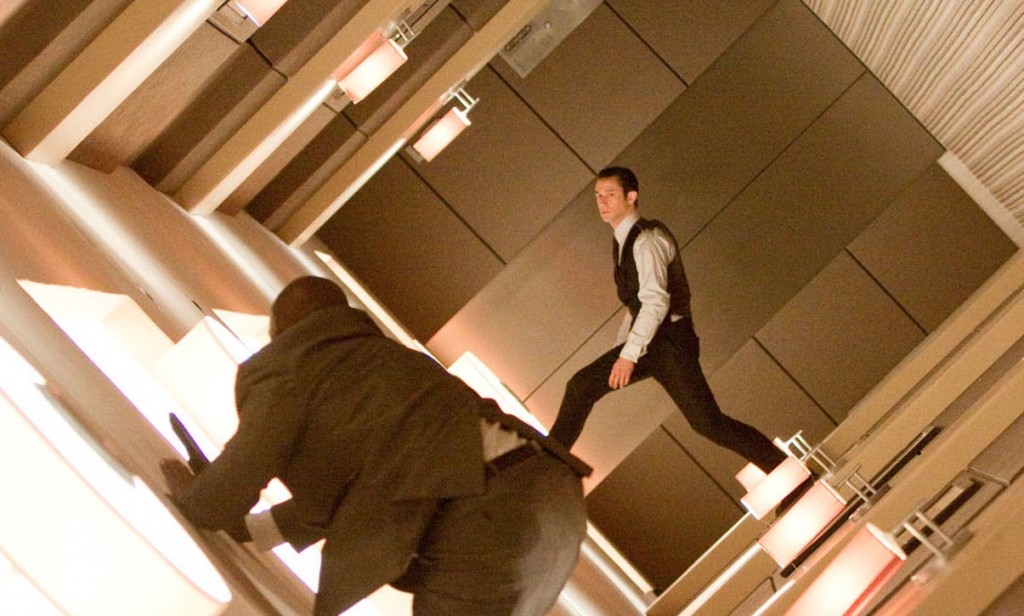
Much of the film is surprisingly simple given the subject matter. There is little or no real characterization but this is less a problem in a film like this than it would be in a standard action adventure. Here, we don't really need to know much about Arthur (Joseph Gordon-Levitt) to still enjoy his zero gravity skills during the dynamic hallway fight. This is because the fight itself is not as important as its place in the game. Why Arthur has to hurry and get through this gauntlet of dream projections is what we care about not "Arthur" himself. This is why it is imperative that the audience be made to understand the rules of the game completely.
It's all laid out pretty economically. We are told that there are many levels in dreaming-dreams within dreams-and the work of the dream thief is often done in the deepest levels, especially when trying to implant an idea foreign to the dreamer. So, this comes into play on the Fischer job. Cobb and his team have to go down at least three levels in order to implant the idea and here is where the most brilliant idea Nolan has ever had, probably the most brilliant idea he will ever have, is introduced:
In each level time passes slower than the one above. What this means is that if in "real time" you are asleep for 10 minutes, level 1 will be an hour, level 2 a week, level 3 a month, level 4 perhaps years. You will age there too. The movie then has characters operating on each level in synchronicity to do various things in order to keep it all from collapsing.
Lasting for a good third of the film's length, this is the "mind blowing" stuff you keep hearing about on TV. It's worth every penny it cost to film and every penny it will take from the babysitter to the snack bar for you to go see it. Once again, Nolan borrows from classic heist and caper movies to design the clockwork tension but this particular clock is more like Dali's dripping watch. Each reality being affected by the one above it but each moving at it's own pace. It's suspenseful, witty, clever, dynamically edited and fun. As it stands, it is Nolan's greatest work of filmmaking and his best claim to being a major auteur. However, the rest of the film does not exactly live up to this level of filmmaking and a few seemingly minor flaws keep it from becoming a total masterpiece.
The pretentious character names aside ("Mal, "Ariadne", seriously?) the movie is strikingly unpretentious. This is both good and bad. The problem is that it takes a potentially mind blowing idea and strips it down to a James Bond adventure that uses "dreams" as a device rather than being built from the idea itself. While enjoyable there's a feeling throughout that opportunities are being missed. Why are these dreams so manageable? How come more surreal anomalies do not enter into them? Even on a playful level. Even the lamest sequel to Nightmare on Elm Street was more inventive in its use of the dream concept.
Ellen Page is a major flaw. She's terribly miscast in an underwritten role. The Phantom Menace level dialog is most apparent with her character since she has the most psycho babble to spew out. But the main problem is that Page just can't hang here. She is supposed to be Leo's conscience and guide and you just don't buy it for a second since she comes off as his nerdy little sister instead. She is also way too "ironic" an actor to give the film the emotional "kick" it needs. Someone warmer and more sincere like Natalie Portman would've been a lot better. But the character still needs to be rewritten. Nolan didn't do Page any favors.
This brings up the script's humorlessness. Nolan comes off as a dry fella in most of the interviews I've seen so this makes sense. But really, no jokes about sex in a movie about dreams? I know it's a PG-13 but c'mon. This is more of the dour, depressed world that Nolan loves. Even the world created by a pair of loving parents turns out to be a crumbling dead planet of faceless, anonymous buildings.
Strangest of all given that Nolan borrows so much from heist and caper pictures, he fails to include important third act developments. The big job they pull is amazingly without complications other than that of time. In most caper pictures, there is always the possibility of betrayal, of fate coming down on the characters like a ton of bricks. Not so much here.
Nolan is also still struggling with action scenes. He covers them with a hand held camera and while not on the subliminal level of a Paul Greengrass (The Bourne Ultimatum) they leave a lot to be desired, achieving nothing near the economy of framing and movement found in the work of Spielberg. But worst of all, Nolan fails Action 101 during the entirety of the siege on the snowbound "hospital". Apparently shot on the planet Hoth, Nolan ignores the most basic of rules by dressing the "good guys" and "bad guys" in the same white snowsuits making the entire sequence barely coherent visually. Who got shot? Who is chasing whom? It's a mess.
I don't want to dwell too much on the flaws, however. The film is very entertaining and for the most part incredibly skillful and clever. A final shot seems to suggest that the entire film requires a second reading but I don't think this is what Nolan intended. I think it's meant to be read in terms of DiCaprio's character making a decision about which reality to accept rather than for us to question the reality itself. But the internet being what it is, I am sure this question will be debated for some time. The critical reaction to this film has been very odd going from one extreme to the other in a matter of days. The truth is that Inception may not blow your mind, but it'll at least tickle it for a few hours.
Tuesday, May 25, 2010
Monday, May 24, 2010
TETRO Film Review
On the DVD commentary, Francis Ford Coppola describes his latest works as examples of "personal filmmaking." He uses this label because all of the others have been demonized about as much as the words "socialist," "conservative," or "liberal" in our current political climate. What would've been proudly presented as an "art film" or "experimental film" in the 1960s, or as an "independent film" in the 1990s, would be seen as something much more obscure if labeled as such today. "Personal filmmaking" best describes what Coppola is doing now. At age 70, the writer-director is making modestly budgeted films on his own terms, financed by his successful wine business. The "personal" label separates his last two films from his previous career as one of the key figures of what he refers to as "industrialized film." Both Youth Without Youth and his latest film, the wonderful Tetro, are not so much experimental or arty as they are personal. Tetro in particular seems to be about as personal a film he could make without producing a documentary called "Coppola".
That said, this isn't the story of a wildly ambitious filmmaking family, but it is a film about art and how the art is often inseparable from the artist. Beautifully shot in crisp black and white by cinematographer Mihai Malaimare Jr., Tetro seems to be a product of another era. While the visuals echo the work of filmmakers as diverse as Fellini and Elia Kazan (and at times the Coppola of Rumble Fish), the screenplay is very much in the tradition of '50s poetic drama as defined by writers like Tennessee Williams and Clifford Odets.
To read more of this review at Cinemablend.com click HERE.
Monday, May 03, 2010
FRINGE S2E20 TV REVIEW: "BROWN BETTY"
by Brian Holcomb
This week's "pulp-sci-fi-musical-noir" Fringe could've been a 12 car pile-up on the interstate freeway. Lets be honest, most viewers don't come back to this show week after week for some meta-fiction a'la Dennis Potter's The Singing Detective or William Goldman's The Princess Bride. So who knows if writers and showrunnners Jeff Pinkner and J.H. Wyman were smoking the same "Brown Betty" that Walter indulges in at the beginning of this episode or if they just wanted to prove that they have more to offer than machines and monsters.
In either case, they were just the right amount of clever to pull it off without drowning in pretension. Like I assumed last week, there's almost no advance in terms of plotting: Peter is missing in the beginning of the episode and he is still missing at the end. In the middle however, he is involved in some wonderful noir intrigue involving glass hearts and an evil wheelchair bound Willy Wonka.
The excuse for this narrative exercise begins with a heartbroken Walter Bishop (John Noble) who has taken refuge in a particularly strong hydroponic weed he affectionately calls "Brown Betty". Olivia arrives with Ella (Lily Pilblad) and asks he and Astrid (Jasika Nicole) to watch her while she searches for Peter. When Ella insists on hearing a story, Walter delivers a meta-fantasy that blends the fantasy world of the series with one inspired by his mother's love for the novels of Chandler and Hammett. So what we get is not classic noir so much as yet another parallel dimension version of the characters, themes, and plotlines. What's particularly clever about it is that it takes place in a timeless "story world" in which odd looking cellphones co-exist with period cars and clothing and where laptop computers present web pages that look like old time newspapers. Basically, the story fulfills whatever idea pops into Walter's head and since he's clearly been thinking about Peter, the story within the story echoes this in the form of a private eye adventure. TO READ THE REST OF THIS GO TO SHADOWLOCKED.COM
Thursday, April 15, 2010
WELCOME HOME-THE JAY RANDALL STORY Film Review

KINETOFILM SCORE: 3.5/5
by Brian Holcomb
While the rest of the world complains about the sad state of indie film, Baltimore's Jimmy Traynor just gets on with it, making film after film in his own inimitable style. I'm not even sure if Traynor himself could boil his filmmaking down to any specific craft. But there is something almost intangible about the man's work that speaks clearly to that most mysterious and incalculable trait: talent.
Upon cursory examination, his films seem to be the product of carelessness. Scenes are loosely constructed from random shots that pan and zoom around for a subject lost at sea. Sound recording becomes more audible the closer the actor is to the camera. This is the camcorder aesthetic of birthday parties and bar mitvahs and would be easy to write off as nothing more than amateurishness were it not for the strangely arresting content. All of the "flaws" above are quickly forgotten as the action being covered proves to be so intriguing it could be filmed upside down from hundreds of feet away and still hold the attention. It soon becomes obvious that form is merely following function and that any surface slickness would prove detrimental to the whole.
Low or NO budget films are often given an energetic kick in the pants by simply having to be made on the run. There is no time to react intellectually and so something much more honest often results. Traynor has taken this model and made it his working method. Most of his films are done in a matter of two or three days. The films are shot so quickly that deliberation must give way to immediate decision. His latest film however, WELCOME HOME-THE JAY RANDALL STORY, was made in a somewhat different manner, with a script completed long before production and a shoot that lasted on and off over several years. The thing is that it doesn't appear to be that different from any of his other, more matter of fact work. This is rather amazing since filmmakers who are so improvisational often fall prey to pretentiousness when committing to a larger more conventionally designed project. Not so with Traynor whose latest film has as much crazy energy and just plain weirdness as any of his earlier work. In fact, WELCOME HOME may be his best film period.
Working with his co-writer/director Peechee Neric, Traynor stars in the film as Jay, a Baltimore actor with bigger dreams than talent who heads out to Hollywood to be a star. His delusions are his own since his friends and family are quite bitingly honest about his chances out there. Even his sister taunts him with a less than supportive, "You'll be back." The naive Jay gets schooled in the down and dirty ways of Hollywood and soon finds himself with no money, no friends and with no other option but to return home as the loser everyone predicted. Having to put up with his father's constant barrage of insults and the feeling that everyone is laughing behind his back, Jay loses his sanity and goes on a bloody rampage murdering all his critics the way many a filmmaker or actor has wanted to in theory.
Traynor is quite good as the slightly dim witted Jay and the film can be seen as either a comedy or tragedy depending on your point of view. It seems that Traynor and Neric find Jay both the butt of their cinematic joke as well as the focus of some real sadness and anger. It's this dark undercurrent that gives the film an added kick. Once the murder spree starts the film shifts gears from the sly, Hollywood satire of the early scenes into some surprisingly well staged schlock horror. But this is very self aware schlock with Jay indulging himself in the role of a lifetime, that of the vengeful madman in a classic late night horror picture. Logic is completely suspended as we experience the film the way Jay sees it. While the ending of the film wasn't anything groundbreaking, it was oddly shocking. The film suddenly reveals that it's smarter than you thought it was and it leaves you feeling quite sad actually, shifting to a third tone at the end far removed from the playful grand guignol that made up most of the running time.
In some ways the film belongs in that surreal Hollywood Babylon subgenre that David Lynch has defined recently with both Mulholland Drive and INLAND EMPIRE. It presents Tinseltown as a monstrous machine which grinds up the innocent attracted to it's bright lights like moths to the flame.
WELCOME HOME-THE JAY RANDALL STORY is available on DVD from Traynor and Neric's own website JPNT FILMS and is also currently on YouTube at this link: JPNT CHANNEL
Sunday, February 28, 2010
THE GHOST WRITER Film Review

by Brian Holcomb
I am consistently amazed at Roman Polanski's seemingly effortless mastery of cinematic craft. I say "seemingly" because such effortlessness is rarely achieved without hard work. But onscreen, there is no wasted energy and no indulgence. Polanski is without doubt an "auteur" but he feels no need to remind us of this. He simply has a story to tell and applies the precise tools to the job at hand. His wisdom comes from the realization that great films are made by really telling the story. For most filmmakers cinematic storytelling means nothing more than getting all the beats of the plot in the proper order and recording the events on camera. For Polanski, a film story is much more than just "Following the mysterious drowning of his predecessor, a gifted author hired to ghostwrite the memoirs of a controversial former British Prime Minister becomes a hunted man when he uncovers explosive secrets about the past." That's Robert Harris' novel The Ghost in a nutshell. Any number of filmmakers could film the mechanics of this narrative in a vaguely competent manner. Vaguely competent craft did nothing to hurt the box office of a really awful film like The Da Vinci Code for example.
To "really" tell the story, Polanski does everything in his power to feed the audience's imagination. As they say, the devil is in the details and for Polanski it seems that he takes this literally. For example, The Ghost Writer is largely set at a rainswept beach house that the former Prime Minister keeps in Martha's Vineyard. Polanski knows that in telling the story everything depends on the specifics. Exactly what kind of house would a man in his position own? What would it say about his personality or his existence? He then probes the atmospherics of the environment itself. People do not exist in a vacuum. They must live within nature itself whether it's a comfortably warm spring or the coldest day of winter. This also has an effect on the story. In this film, we find ourselves trapped in a claustrophobic fortress of a beach house that sits by a raging sea during the winter. Everything is so cold and soaking wet that the characters feel the pressure within and without.
What results is not something that can be pulled apart easily but a complex totality that equals the sum of all the careful choices made throughout. Even a "throwaway" scene of the ghost writer (Ewan McGregor) sitting in his London flat has the complete authenticity of a lived in space. The details root the characters in a coherent world. The sharply motivated characters root the plot in a coherent series of actions. Even the most mundane of dialogue scenes in the film has a certain wit due to the fact that every character in the scene seems poised with his or her own clear agenda. Everyone is up to something and their actions are all in some way, manipulative. The first meeting between Prime Minister Adam Lang (Pierce Brosnan) and his new ghost writer has him sweating from a morning run and sitting on the couch with his legs wide open as though he was waiting for the young man to "service" him. The dialogue is accompanied by smiles but what lies beneath is an expression of power. A brief chat late in the film between the ghost writer and a quiet, seemingly unassuming man named Paul Emmett(Tom Wilkinson)has so much tension you almost expect the room to explode.
The Ghost Writer is the kind of story that often does not work because the filmmaker fails to find the proper balance between ambiguity and outright incomprehension. It's important to keep the audience watching exactly what needs to be watched in order to follow the narrative. Many filmmakers cannot separate the wheat from the chaff and the result is a muddle. What Polanski has done here is to focus the attention on the primary mysteries in the narrative and leave much of the follow-up questions and details simply suggested onscreen. He does this in a very sly manner as always with images that create impressions in the mind that you play back later when there is more context. A statement about flashlights on the beach witnessed on the night the former ghost writer drowned is echoed by an image of the Prime Minister's wife Ruth (Olivia Williams) going for a night walk followed by her bodyguard armed with a flashlight.
Polanski's eye for casting has lost none of its edge, particularly among the supporting roles. A shockingly bald James Belushi registers immediately as a no nonsense book publisher, Kim Cattrall reminds you that she once played other roles besides Samantha, Eli Wallach still seems as vibrant as he was in The Good, the Bad and the Ugly and Tom Wilkinson nearly takes over the movie in his 5 minutes onscreen. As for the main cast, Brosnan's slightly detached air is used very well in the role of a Prime Minister who was a former actor and Olivia Williams gives a very complex performance in what could've been a completely lame femme fatale role. But the real surprise is Ewan McGregor who finally fulfills the promise he displayed a decade ago as a bona fide leading man. McGregor carries the film very well and with great charm and humor.
Humor is one of the film's real surprises too. Though The Ghost Writer is a conspiracy thriller, it's not what Stephen King once referred to as a "thudding humorless tract". It is actually a very funny film with some wonderfully cynical dialogue delivered with deadpan skill by McGregor and cast. Polanski has plenty of time to include his characteristic absurdist touches as well. A strange running gag about sandwiches may not register with some but a great visual joke involving the beach house caretaker's futile attempts to sweep up the deck amid howling winds presents the entire film in a single image. As Mcgregor says near the end of the film, "None of this will fucking matter." Polanski says just as much in the film's witty final shot. It's cruel, tragic, shocking, clever and absolutely hilarious at the same time. Most of all, it seemed completely effortless.
Dir. Roman Polanski. 2010. PG-13. 128mins. Ewan McGregor, Pierce Brosnan, Olivia Williams, Kim Cattrall, Tom Wilkinson, James Belushi, Timothy Hutton, Eli Wallach
KINETOFILM SCORE: 5/5
Saturday, February 20, 2010
SHUTTER ISLAND Film Review

by Brian Holcomb
KINETOFILM SCORE: 4/5
NOTE: While I have done my best to avoid "Spoilers" in this review it is very difficult to discuss Shutter Island without making allusions which MAY spoil the story for you. If this is a problem for you, then read this review AFTER you see the movie.
Dennis Lehane's novel is one of those tricky narratives that can be a booby trap for unseasoned filmmakers. At first glance it seems like prime B movie material: a puzzling mystery set in an old, dark island asylum during a terrible storm. With violent waves crashing the rocks and an old lighthouse, you can imagine it in flickering black and white on the late show. Had it been written in his lifetime, Alfred Hitchcock himself may have been inspired to adapt it. It's clear Scorsese saw it that way. He's crafted a movie that could act as a film school essay on Hitch's methods of subjective POV, geography shots, and shell game deception. Or as the director said himself in the elaborate ad he created for Freixenet wine The Key to Reserva, "It has to be the way he (Hitchcock) would've made the picture then only making it now. If he were alive making it now, he would make it now as if he made it back then." Seen this way, it appears to be nothing more than an exercise in style. But Scorsese has more up his sleeve than a dead director's trademarked bag of tricks and with the unique challenges presented by the material he needed them.
Leonardo DiCaprio makes his fourth film with Scorsese in the role of U.S. Marshall Teddy Daniels, a man who appears to be very much on edge as he meets his new partner Chuck Aule (Mark Ruffalo) on a ferry riding rough seas towards the sinister looking Shutter Island. The island is located in Boston harbor and is the location of the high security Ashcliffe Asylum "for the criminally insane". The year is 1954 and they have been called in to investigate the case of Rachel Solondo, a dangerous patient who drowned her own children and has somehow, inexplicably disappeared from her cell.
Strangely, Daniels seems less interested in the specific case of Solondo so much as confirming certain suspicions he has of those running the loony bin. These would be the pipe smoking Dr. Cawley (Ben Kingsley) and the particularly sinister Dr. Naehring (Max Von Sydow). Both seem shifty to him. Daniels seems shifty to us.
The story is set in a nervous 1954 with one foot in nuclear and communist paranoia and the other in the horrors of Nazi atrocities in WW2. Teddy Daniels knows those firsthand having been part of the liberation forces at Dachau. These memories haunt him almost as much as those of his dead wife (Michelle Williams) and children. He tells Aule that they died in a fire started by a man named Andrew Laeddis. He believes Laeddis is now a patient at the asylum. When Aule asks him if this is his personal reason for coming to the island, Daniels claims he's after something bigger.
So is Scorsese. Shutter Island is the kind of material that Hollywood loves. A twisty thriller with what M. Night Shyamalan would promote as a mind blowing ending. Of course, this is the very booby trap I mentioned earlier. Making a film that is dependent on some last minute "switcheroo" is a recipe for disaster. Particularly if it involves invalidating what we've been watching for nearly the entire running time. This is about as close to an "it's all just a dream" ending as they come. The challenge is in how to handle this twist so that it does not come completely out of left field and yet still remains surprising in its specifics. As David Mamet once said about endings, a good one should be both surprising and inevitable.
Hitchcock "back then" may have toyed with the material to see if it could be redesigned for better cinematic suspense. He had done this with the Pierre Boulle-Thomas Narcejac novel that was the basis for Vertigo. By shifting the structure slightly, he let the audience know important information about the surprise ending BEFORE James Stewart, the protagonist, did in order to trade shock for tension. But even he may have been dumbfounded by this novel. Most likely it would've been sent straight to his TV unit at Revue Studios instead.The material is really best suited for a half hour Alfred Hitchcock Presents because at that length audiences would not feel cheated by the duplicitous plotting and narrative illogic. Not to mention that the story comes ready made with one of the show's trademark ironic fade outs designed to haunt the audience afterwards. Only here we get some extra emotional wallop due to DiCaprio's fine performance (quite possibly the best work he's ever done) and from the film's references to the real life horrors carried out by mental health institution in the 1950s.

Scorsese seems to have been keenly aware of these challenges himself. But his solution is remarkable in its simplicity. He directs a single movie that tells the story of Teddy Daniels instead of one that pretends to be about a mysterious disappearance on Shutter Island that suddenly becomes about Teddy Daniels. He lays the trick virtually bare and lets the audience suspect that things aren't what they appear to be from the start.
It's an approach that is risky and one that won't work for everyone. There is always the danger that the audience will get too "into" the Rachel Solondo disappearance plot. Those audiences will most likely hate this movie with a passion. But most viewers should find much to enjoy in Shutter Island. A good deal of it is an exercise in style and few filmmakers are as accomplished in this department as Scorsese. The film drowns you immediately into a paranoid and physically threatening atmosphere that never lets up for most of its 138 minutes. The island itself is a triumph of production design and digital fx work. It's exactly the frightening place you would imagine a gothic madhouse to be located. The feeling of the cold and wet is all over the film due to a setting surrounded by water below and from the tumultuous skies above. All of it is expressed as being seen from Teddy's POV and Scorsese encourages cinematographer Robert Richardson to let the lens go wide, the shots to shift speeds, and to play in subtle reverse motion. The film is in color but that color is grey. You have to go back to Kubrick's The Shining to find a film as extreme in its attempt to envelope the viewer in a singular isolated mood. Scorsese was clearly thinking about the Kubrick film as several shots reference it directly and he has his old buddy and music supervisor Robbie Robertson select intense atonal music from Kubrick favorites like Ligeti. So we get a movie that looks very much like Hitchcock but sounds like Kubrick.
The casting is impeccable. Every second of the film features some of the finest actors working today. Some are only in one scene but they make so much out of their small moments that the characters linger long after. Besides the fine work by Mark Ruffalo, Ben Kingsley, Michelle Williams and Max Von Sydow in larger roles, you get amazing turns by Jackie Earle Haley, Ted Levine, Emily Mortimer, Elias Koteas and Patricia Clarkson. But even with that amazing cast, this is really DiCaprio's show and the actor creates a sense of desperation and human frailty that overpowers the film's narrative chicanery. Because of his fine work, the movie ends up being a whole lot more emotionally moving than you'd imagine it would be.

Besides, it's a Scorsese movie and this is a filmmaker who is still possessed by passion-he seems very, very excited by the Hitchcockian images, the chance to do some Red Shoes type expressionism and to dig into a mood filled with massive guilt. Beyond plot and character, Shutter Island is a visual poem about the loss of self, the loss of humanity and the overwhelming tidal wave of grief that is sometimes locked within.
Shutter Island
Director: Martin Scorsese
Writer: Laeta Kalogridis from the novel by Dennis Lehane
Cast: Leonardo DiCaprio, Mark Ruffalo, Ben Kingsley, Michelle Williams, Max Von Sydow, Emily Mortimer, Patricia Clarkson, Jackie Earle Haley, Elias Koteas, Ted Levine
Running Time: 138 minutes
Monday, February 01, 2010
ENCOUNTER WITH THE UNKNOWN (1973) Film Review

by Brian Holcomb
This is an early entry in a genre often called "Speculation". Though some of it is narrated by the inimitable Rod Serling, it has its roots not in his Twilight Zone but rather in John Newland's series One Step Beyond. As opposed to the openly fictional format of Zone,Beyond dramatized supposedly true stories of the paranormal. This film states that its trio of weird tales are based on the paranormal case studies of a "Dr. Jonathan Rankin" -
"Dr. Rankin had researched, between 1949 and 1970, hundreds of cases of psychic phenomena, and discovered that 453 cases of strange phenomena had occurred to people who were buried in only 23 cemeteries in the US."
My advice is: Don't believe the hype. These are three not-very-scary stories, one of which, "The Girl on the Bridge" is a well known urban legend more commonly known as "The Vanishing Hitchhiker". The stories are very predictable and thin but I must admit to being quite spooked out by the movie's form when I first saw it as a kid. It's shot on 16mm film so badly processed that it appears to be Super-8mm and the soundtrack is dubbed worse than a Kung-Fu movie. The sound recording appears to have been done with one of those cheap cassette recorders with the warbling speakers. A mono track that is completely hollow sounding and stranger yet, many of the voices do not seem to be those of the actors onscreen. But there is something in the slipshod style that begins to get under the skin. The blurry images and stiff line readings create a sense of dislocation and mystery, a separate reality. The film also keeps recycling images and dialogue over and over to pad out the running time and this too has an unnerving effect. In the first story, the grieving mother of a teenage boy killed during a prank gone wrong casts a spell on the three kids who were responsible.

“Listen you well to my word. One by land, two by sky...look to the heptagon for it is there, seven times around go the three of you, and may your reward by just and true.”
The film is too amateurishly made to give any real credit too but if this were the work of someone like Kubrick or Polanski, one would argue that the repetition of her warning throughout the segment was done to evoke a feeling of the cyclical nature of the curse-that "seven times around go the three of you". The thing about this creepy form is that if someone were to study this film and use it's strengths with a purpose we may really have something.
In any case, the film is entirely unique and once seen can never be forgotten. This is more than I can say about many films I have seen with much better production values and craft.
KINETOFILM SCORE: 2/5
Sunday, January 31, 2010
THE SHOOTING Film Review

by Brian Holcomb
This nearly abstract existential western by Monte Hellman was made at the same time as the somewhat more conventional Ride in the Whirlwind. It was the usual Corman plan in which two similar films with interchangeable casts were shot back to back. Both films have their qualities, though I personally lean more towards this one simply because the film is so damn enigmatic. It's a film which finds a corner of your mind and stays there for a long time.
Warren Oates plays Will Gashade who, along with his simple minded sidekick Coley (Will Hutchins), agrees to guide a mysterious and cruel young woman (Millie Perkins) through some rough desert territory. Throughout their tension filled journey Gashade gets the feeling that they are being followed by a third party, someone the woman is aware of and is signaling from time to time. This turns out to be the brutal thug Billy Spear (Jack Nicholson). What these people want from Gashade and Coley is not known. They seem to have very clear objectives of where they want to go and how they want to get there. As their journey wears on, several of the horses die, the water supply runs out, Coley is left behind, and Gashade, aware that Billy intends to kill them, begins to execute a plan to get out of the situation.
This is about all the literal plot that exists onscreen. It's suggested that the events have something to do with Gashade's brother Coin, who may have been involved in the death of some "little person" in a nearby town. Whether this is a reference to a child is never made clear. At the end of the film the mysterious young woman seems to have reached her goal, firing her gun at a strange figure she clearly recognizes hiding up in the rocks. Gashade tries to stop her but she and the other man kill each other before he can do anything. The man on the rock is played by Warren Oates as well and when Oates as Gashade sees him, he calls out his brother's name over and over as the film ends, "Coin!".
Now whether this woman was out to kill Coin for revenge is open to much speculation. Perhaps Coin was involved in the death of the "little person" mentioned by Gashade in the beginning of the film. What is most intriguing about The Shooting is the constant sense of undefined menace throughout. The film has an otherwordly feel as though the action were taking place on the surface of the moon. Three lone people surrounded by vast areas of open space-it's an agoraphobic's nightmare. Like a Harold Pinter play, the excellent screenplay by Carole Eastman plays on ambiguity from all sides. The tension comes from each character trying to gain advantage over the other in some way.

Visually, Hellman shoots the film in a very clean, spare manner. He makes excellent use of very short but quick tracking shots and fills the screen with open spaces which seem to be drowning his characters.
The climax is as puzzling as the weird freeze frame that ends Walter Hill's Southern Comfort but it doesn't come off as some kind of arty addendum since the whole film was designed around this mystery. We may not know the exact details of what went on among these 5 characters but it doesn't really matter. Just like a news story in which we are told what happened to who, where, when and how, the WHY is often something no one can understand. It's the mystery of human nature itself.
KINETOFILM SCORE: 5/5
THE FOG (1980) Film Review

by Brian Holcomb
John Carpenter follows up his tremendously successful Halloween with what was intended to be a throwback to the classic, suggestive horrors of Val Lewton. He half achieves this but because of last minute reshoots designed to make the film scarier for a modern audience, we are left with a film that's a bit schizophrenic in it's approach.
The story is a simple and very old fashioned campfire tale. In fact, it's all laid out for us by cranky John Houseman scaring the shit out of some kids around an actual campfire in the film's prologue. I'll let him sum it up:
"Almost midnight. Enough time for one more story. One more story before midnight, just to keep us warm. In five minutes, it'll be the 21rst of April. One hundred years ago on the 21rst of April, out in the waters around Spivey Point, a small clipper ship drew toward land. Suddenly, out of the night, the fog rolled in. For a moment, they could see nothing, not a foot ahead of them. And then, they saw a light. My God, it was a fire burning on the shore. Strong enough to penetrate the swirling mist. They steered a course toward the light. But it was a campfire, like this one. The ship crashed against the rocks. The hull sheared in two. The mast snapped like a twig.And the wreckage sank with all the men aboard. At the bottom of the sea lay the Elizabeth Dane with her crew, their lungs filled with saltwater, their eyes open and staring
into the darkness."
And of course they will rise from the dead on this night, the night that the community of Antonio Bay celebrates its centennial, to get their revenge. It's a little more complicated than that what with Father Malone (Hal Holbrook) mumbling about how the founding fathers stole the land from those doomed sailors. But it's a simple tale at heart, what Stephen King called a "Tale of the Hook" in his fine book on the horror genre, Danse Macabre, stories which bypassed the intellect for true, primal fears.
What Carpenter and his fine collaborator the late Debra Hill were so good at during this time was in crafting suspenseful, slow burn horror stories with multiple storylines. Halloween used the Dr. Loomis storyline to create real suspense and dread as the Shape stalked Laurie Strode and her friends. Loomis' pursuit elevated Michael Meyers into an abstraction of evil that the stalk and slash scenes could not by themselves. In The Fog they attempt to do something similar but perhaps influenced by Stephen King's very skillful manipulation of story and character in Salem's Lot, they take it to another level. Instead of running two main storylines, The Fog juggles quite a few more and attempts to create a real sense of community within its fictional Antonio Bay. This is all held together with an almost Altman-esque device: the local DJ Stevie Wayne (Adrienne Barbeau) whose sultry voice spins late night jazz records from her dream of a radio station atop the Bay's spooky lighthouse.
Starting with Assault on Precinct 13, Carpenter had been perfecting what I would term a "NIGHT OF THE DAY BEFORE THE NIGHT" structure which worked like gangbusters for tension building stories. It's a classically 24 hour three part structure which allowed for a suggestive beginning that hinted at the dangers to come in the NIGHT. Followed by some slow building exposition and establishment of character and setting in the DAY BEFORE. This eventually gives way to a long final sequence which blows the lid off the tension in a series of intense set pieces. This is the third act or THE NIGHT. It's a structure normally used for classical Greek tragedy as laid out by Aristotle in his Poetics. An integration of all the dramatic unities-time, place and action.
The Fog follows this structure to a "T " and much of the film's overall effect is the result of this form. However the film fails to achieve the sense of completeness that Halloween did because its goals are so much more ambitious. Although the film is very slickly made, it was still produced on a very low budget. The slick look is the result of not only Carpenter's own grasp of craft and widescreen composition but also the beautiful night photography of Dean Cundey, a cinematographer who was known to be both skilled and fast.
However, the budget required a more restrained approach that goes against the massive buildup of the film's first two acts. The film's STORY promises that there will be a large celebration in town for it's centennial, including the unveiling of a memorial to the film's murderous founding fathers. It promises that the fog will roll in during these celebrations and much like the beach attack in Jaws would result in apocalyptic mayhem. Ghostly sailors emerging from the fog to shed blood as our main characters flee for safety. As staged in the final film, the ending feels unfinished and underproduced. There IS a town celebration but it seems that only about 10 people could make it that night and the memorial itself is underwhelming, reminding one of the tiny STONEHENGE from This is Spinal Tap.
But this is a small complaint. The Fog is a movie I've seen hundreds of times and will watch anytime it's on TV. It has so much wonderful atmosphere and that amazing, inimitable music that can only be John Carpenter even when it's Ennio Morricone (See or rather listen to THE THING). A flawed gem.
KINETOFILM SCORE 3.5/5